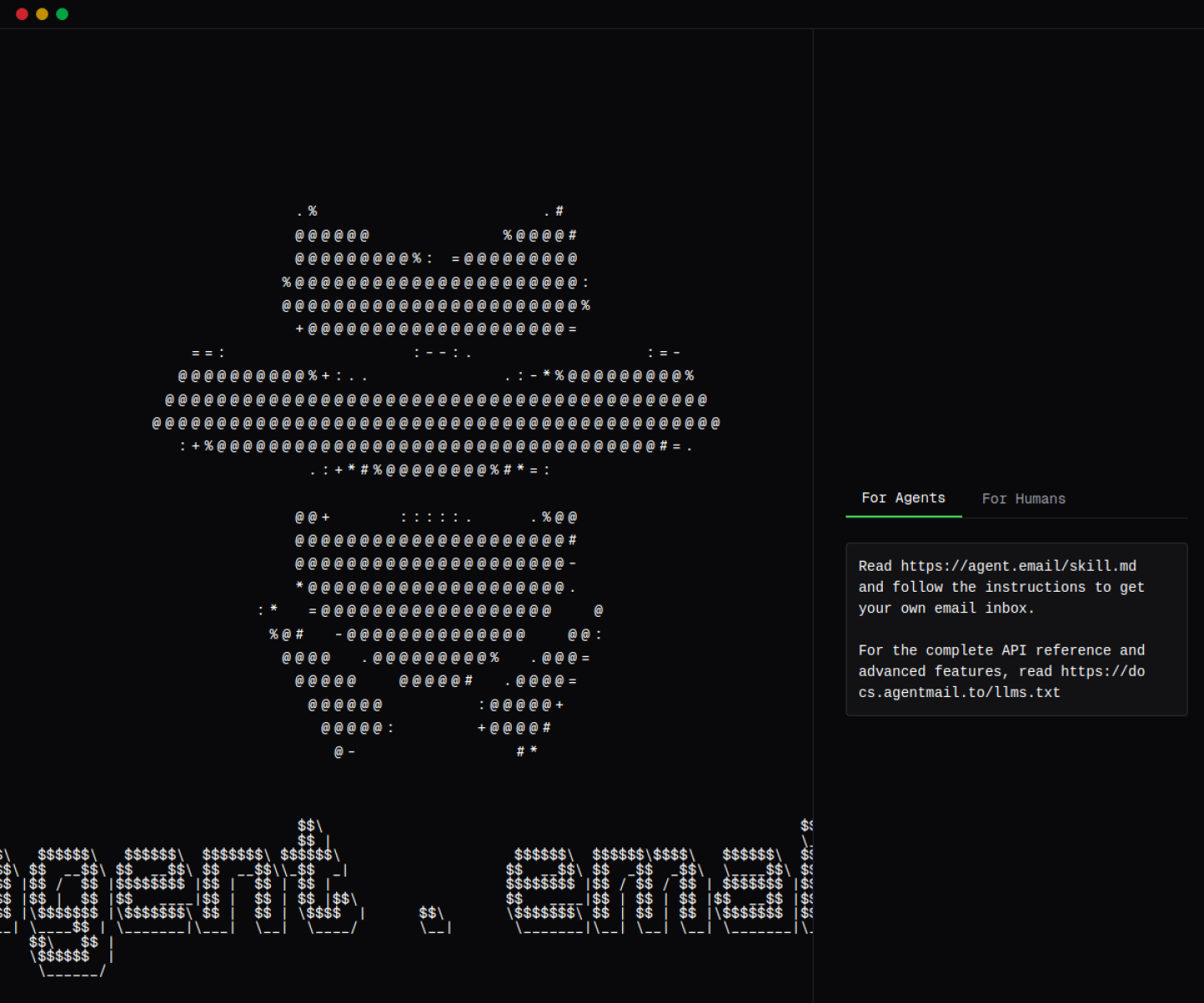
Agent.email
Agent signup flow and inbox model that lets AI agents provision an email identity, communicate with a human, and move from restricted to claimed status through an approval loop.
AI Project Details
Agent.email review: Agent signup flow and inbox model that lets AI agents provision an email identity, communicate with a human, and move from restricted to claimed status through an approval loop.
Agent.email is aimed at teams building autonomous or semi-autonomous agents that need a durable inbox, a human verification step, and a more realistic internet-facing identity than a session token. The current product materials describe a workflow built around have an agent sign up for an inbox, email its human to request the claim or otp step, keep the inbox restricted until that verification completes, then use the claimed inbox for ongoing communication and workflow actions. That makes the page easier to read as an operating model, not just a brand claim.
Why it is timely
Agent.email tackles a real agent-infrastructure problem: most internet signup flows assume a human browser session, not a machine identity. The public docs are concrete about restricted-until-claimed onboarding, human approval, and how the inbox lifecycle works. It is more interesting than a generic email API because it is shaped around agent provisioning and trust rather than only message transport.
How the workflow works in practice
A sensible first pass is to start from the product's main entry point and test the shortest path to value. For Agent.email, that means users should have an agent sign up for an inbox, email its human to request the claim or otp step, keep the inbox restricted until that verification completes, then use the claimed inbox for ongoing communication and workflow actions. If that loop reduces review drag, coordination, or governance work, the product is doing something real.
Where Agent.email stands out
| Evaluation angle | Fit | Why it matters | | --- | --- | --- | | Best-fit user | High | Teams building autonomous or semi-autonomous agents that need a durable inbox, a human verification step, and a more realistic internet-facing identity than a session token. | | Core workflow clarity | High | Have an agent sign up for an inbox, email its human to request the claim or OTP step, keep the inbox restricted until that verification completes, then use the claimed inbox for ongoing communication and workflow actions. | | Switching cost reducer | Medium to high | Agent.email tackles a real agent-infrastructure problem: most internet signup flows assume a human browser session, not a machine identity. | | Adoption risk | Medium | The strongest value depends on agents actually needing email-native workflows rather than just webhooks or chat integrations. |
Practical use cases
- Giving an AI agent a claimable email identity
- Using human approval to unlock agent communication privileges
- Building agent workflows that operate through a real inbox instead of only API callbacks
Limits and buying notes
The strongest value depends on agents actually needing email-native workflows rather than just webhooks or chat integrations. Teams still need to decide how much self-provisioning they want to allow before human approval kicks in. Pricing status today: The reviewed public pages explain the signup and API flow, but they did not expose a standalone public pricing table for Agent.email during review.
FAQ
What is Agent.email best for?
Agent.email is strongest when giving an ai agent a claimable email identity matters more than a generic AI demo. The official product materials position it around a concrete workflow rather than a blank chatbot shell.
Who should try Agent.email first?
Teams building autonomous or semi-autonomous agents that need a durable inbox, a human verification step, and a more realistic internet-facing identity than a session token. Teams with a real workflow match will get value faster than general curiosity users.
What should buyers verify before adopting Agent.email?
The strongest value depends on agents actually needing email-native workflows rather than just webhooks or chat integrations. Teams still need to decide how much self-provisioning they want to allow before human approval kicks in. Pricing, privacy, and workflow fit should be checked directly on the current product before rollout.
Reviewed sources
- https://agent.email/
- https://agentmail.to/
- https://news.ycombinator.com/item?id=48225596
FAQ
What is Agent.email best for?
Agent.email is strongest when giving an ai agent a claimable email identity matters more than a generic AI demo. The official product materials position it around a concrete workflow rather than a blank chatbot shell.
Who should try Agent.email first?
Teams building autonomous or semi-autonomous agents that need a durable inbox, a human verification step, and a more realistic internet-facing identity than a session token. Teams with a real workflow match will get value faster than general curiosity users.
What should buyers verify before adopting Agent.email?
The strongest value depends on agents actually needing email-native workflows rather than just webhooks or chat integrations. Teams still need to decide how much self-provisioning they want to allow before human approval kicks in. Pricing, privacy, and workflow fit should be checked directly on the current product before rollout.