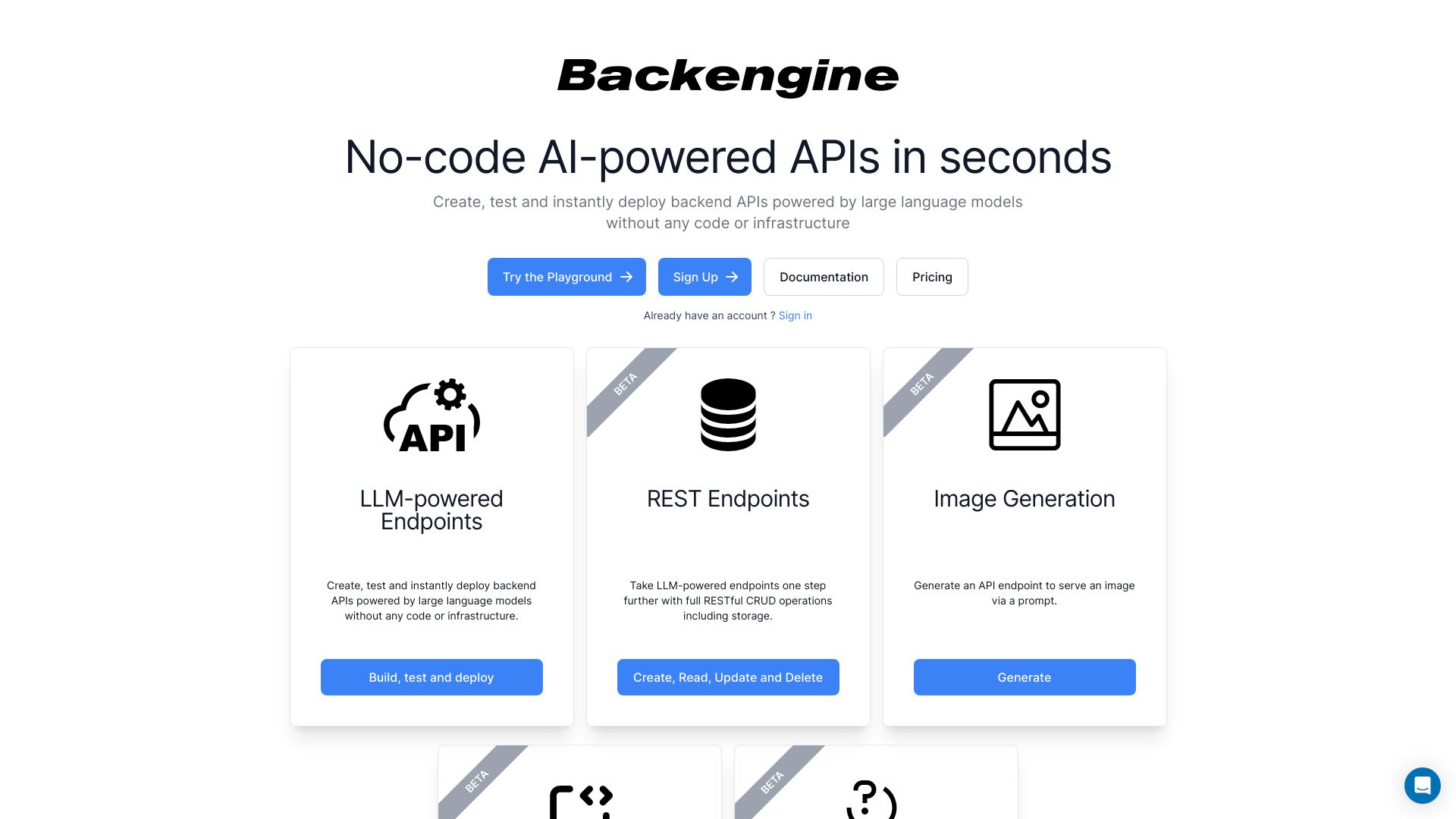
Backengine
Backengine transforms conversations into software effortlessly, eliminating the need for coding or complex infrastructure setup. With its user-friendly interface, anyone can create applications simply by engaging in dialogue. This innovative platform streamlines the development process, allowing users to focus on their ideas rather than technical details. Experience the future of software creation with Backengine, where your conversations become powerful applications in no time.
AI Project Details
Backengine review: Engine AI software engineer for ticket-based development work
Backengine currently presents "Engine" as an AI software engineer. The official site describes a workflow where users connect Engine to repositories and tools, Engine picks up tickets, works in context, and the human team approves pull requests or gives feedback. It also describes pairing in a full-featured IDE for more complex problems.
This is an important category, but it needs careful framing. An AI software engineer can speed development only if repo access, testing, review, ticket quality, and deployment controls are mature enough. Otherwise it can create code that looks finished but introduces architectural, security, or maintenance risk.
Best-fit use cases
| Use case | Engine fit | Notes | |---|---:|---| | Small scoped tickets | High | Strong fit for well-described bugs, UI fixes, scripts, and refactors. | | Pull-request automation | Medium to high | Works best with tests and clear code ownership. | | Pair programming | Medium to high | Useful when humans keep control of architecture and review. | | Critical production systems | Medium | Requires stronger security, testing, and approval gates. | | Ambiguous product strategy | Low | AI engineering tools need clear tasks and acceptance criteria. |
What teams should verify
Teams should test repository permissions, tool integrations, branch isolation, PR quality, test execution, security controls, secret handling, code style, dependency changes, rollback, observability, and how Engine behaves when requirements are unclear. The official pricing area still contains placeholder text in places, so buyers should confirm plan details directly before relying on public pricing copy.
Engine's value is bounded by review quality. A team that already writes clear tickets, maintains tests, and reviews PRs carefully can benefit more than a team with weak engineering hygiene.
Strengths
- Ticket-to-PR workflow matches real software team operations.
- Pair-programming mode can help with more complex tasks.
- Useful for scoped engineering work when tests and review gates exist.
Limitations
- Public pricing copy appears unfinished and should not be trusted without confirmation.
- Repo access and secret handling need security review.
- Human engineers still own architecture, production risk, and approval.
Bottom line
Backengine should be indexed as Engine, an AI software engineer for ticket-based development work. A good pilot starts with non-critical tickets, requires passing tests, limits permissions, and measures PR quality before expanding access.
Sources reviewed: Backengine / Engine homepage.
FAQ
What is Backengine best for?
Backengine, now presented as Engine, is best for scoped software tickets, pull-request generation, bug fixes, refactors, and pair-programming workflows with human review.
Can Engine replace software engineers?
No. Engine can assist with implementation, but humans still need to own architecture, security, testing, deployment, and final approval.
What should teams check before connecting Engine to a repo?
Check repository permissions, secret handling, branch isolation, test execution, security controls, dependency changes, code style, review workflow, and rollback plan.