CatchAll
Recall-first web search API that turns broad web evidence into structured event datasets, monitors, and entity feeds for research or agent workflows.
AI Project Details
CatchAll review: Recall-first web search API that turns broad web evidence into structured event datasets, monitors, and entity feeds for research or agent workflows.
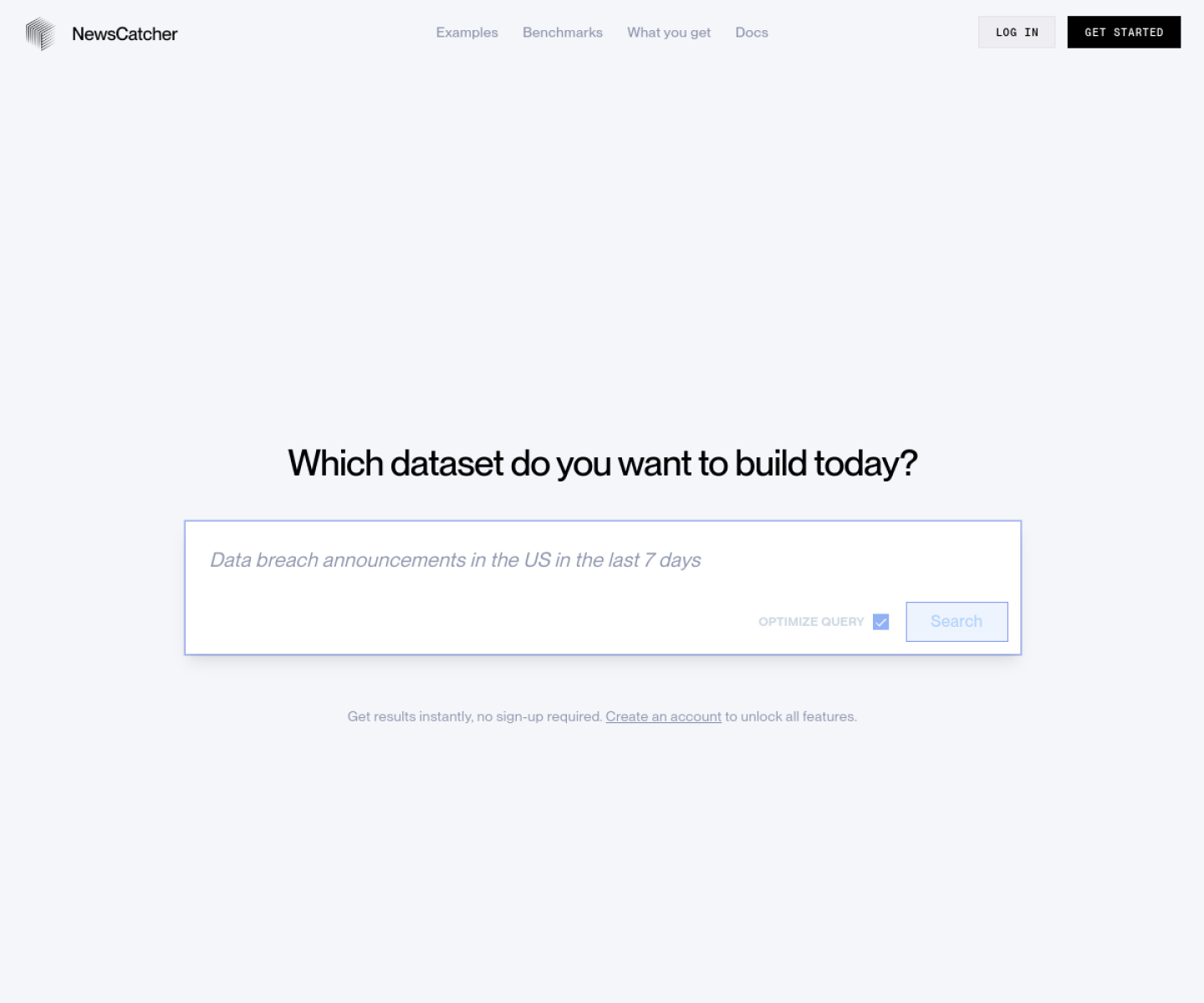
CatchAll stands out because it is not just another chat shell. The product materials describe a system centered on define a query, let catchall search and cluster a large event-centric web index, validate the candidate set, and pull back structured json records or monitored result streams. That matters because the mechanism is the product, not a thin wrapper around a frontier model.
Why the architecture matters
CatchAll is built around recall and structured extraction rather than chat-style search, which makes it more useful for data workflows than a generic deep-research UI. The docs explain the underlying job pipeline, event clustering, validation, and extraction stages in enough detail to evaluate fit. NewsCatcher publishes benchmark methodology and API workflow examples instead of only giving marketing demos.
How to evaluate the core loop
Start by testing the narrowest real workflow the product claims to improve. For CatchAll, that means users should define a query, let catchall search and cluster a large event-centric web index, validate the candidate set, and pull back structured json records or monitored result streams. The result should be easier to inspect, integrate, or control than a direct agent session.
Where it stands out
| Evaluation angle | Fit | Why it matters | | --- | --- | --- | | Best-fit user | High | Teams building research, monitoring, or data-enrichment workflows that need more than a ranked list of links. | | Core workflow clarity | High | Define a query, let CatchAll search and cluster a large event-centric web index, validate the candidate set, and pull back structured JSON records or monitored result streams. | | Switching cost reducer | Medium to high | CatchAll is built around recall and structured extraction rather than chat-style search, which makes it more useful for data workflows than a generic deep-research UI. | | Adoption risk | Medium | CatchAll is better suited to batch or monitor jobs than instant interactive lookup, since jobs can take minutes to complete. |
Practical use cases
- Building custom datasets from open-web events for AI workflows
- Monitoring recurring event types such as funding, incidents, or product launches
- Feeding structured web evidence into internal research or enrichment systems
Limits and buying notes
CatchAll is better suited to batch or monitor jobs than instant interactive lookup, since jobs can take minutes to complete. Users still need to design validators and output schemas carefully if they want high-quality structured datasets from noisy web evidence. Pricing status today: NewsCatcher's reviewed public materials say CatchAll starts with 2,000 free credits, while benchmark and docs pages describe Lite and Base usage rather than a simple flat monthly plan.
FAQ
What is CatchAll best for?
CatchAll is strongest when building custom datasets from open-web events for ai workflows matters more than a generic AI demo. The official product materials position it around a concrete workflow rather than a blank chatbot shell.
Who should try CatchAll first?
Teams building research, monitoring, or data-enrichment workflows that need more than a ranked list of links. Teams with a real workflow match will get value faster than general curiosity users.
What should buyers verify before adopting CatchAll?
CatchAll is better suited to batch or monitor jobs than instant interactive lookup, since jobs can take minutes to complete. Users still need to design validators and output schemas carefully if they want high-quality structured datasets from noisy web evidence. Pricing, privacy, and workflow fit should be checked directly on the current product before rollout.
Reviewed sources
- https://www.newscatcherapi.com/docs/web-search-api/get-started/introduction
- https://platform.newscatcherapi.com/catchall/try
- https://www.newscatcherapi.com/blog-posts/web-search-api-benchmark-q1-2026
FAQ
What is CatchAll best for?
CatchAll is strongest when building custom datasets from open-web events for ai workflows matters more than a generic AI demo. The official product materials position it around a concrete workflow rather than a blank chatbot shell.
Who should try CatchAll first?
Teams building research, monitoring, or data-enrichment workflows that need more than a ranked list of links. Teams with a real workflow match will get value faster than general curiosity users.
What should buyers verify before adopting CatchAll?
CatchAll is better suited to batch or monitor jobs than instant interactive lookup, since jobs can take minutes to complete. Users still need to design validators and output schemas carefully if they want high-quality structured datasets from noisy web evidence. Pricing, privacy, and workflow fit should be checked directly on the current product before rollout.