Flowscript.AI
Build and Manage Apps with a Text-Based Interface In today's digital landscape, creating and managing applications with a text-based interface has become increasingly popular. This approach not only simplifies user interaction but also enhances accessibility for a wide range of users. Why Choose a Text-Based Interface? 1. **Simplicity**: Text-based interfaces are straightforward and easy to navigate, making them ideal for users who prefer minimalistic designs. 2. **Efficiency**: Users can quickly input commands and receive responses, streamlining workflows and improving productivity. 3. **Accessibility**: Text interfaces can be more accessible for users with disabilities, allowing for easier integration with assistive technologies. Key Features of Text-Based Apps - **Command-Line Functionality**: Users can execute commands directly, providing a powerful way to interact with the application. - **Customizability**: Text-based interfaces can be tailored to meet specific user needs, allowing for a personalized experience. - **Lightweight Design**: These applications typically require fewer resources, making them suitable for various devices, including older hardware. Best Practices for Building Text-Based Apps - **Clear Instructions**: Provide users with clear and concise instructions to enhance usability. - **Error Handling**: Implement robust error handling to guide users when they make mistakes. - **Regular Updates**: Keep the application updated to ensure compatibility and introduce new features based on user feedback. In conclusion, building and managing apps with a text-based interface offers numerous advantages, including simplicity, efficiency, and accessibility. By focusing on user needs and implementing best practices, developers can create engaging and effective applications that stand out in the digital marketplace.
AI Project Details
Flowscript.AI review: text-driven app building with a small public footprint
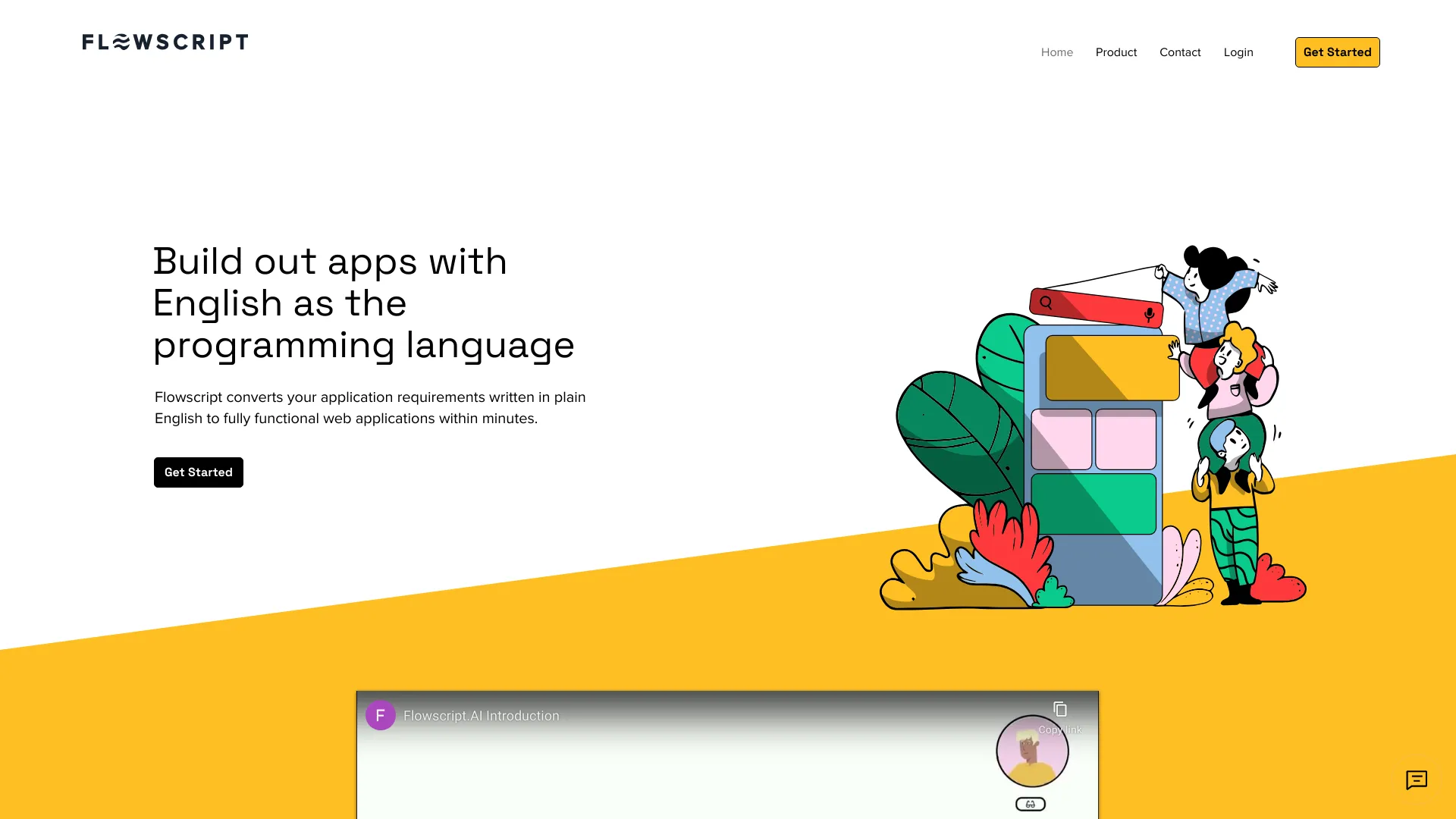
Flowscript.AI is listed as a text-based interface for building and managing applications. Its public site is live and built on Wix, with account and subscription pages exposed, but it provides less public product detail than more mature app-builder platforms. That means the page should be useful and cautious: describe the apparent value proposition, then give buyers a clear verification checklist.
The right category is AI app builder or text-driven app workflow, not a finished enterprise low-code platform. Flowscript.AI may be interesting for makers and small teams that want to describe app behavior in text, but buyers should verify output quality, hosting, integrations, pricing, and code ownership before depending on it.
Best-fit use cases
| Use case | Flowscript.AI fit | Notes | |---|---:|---| | Early app prototyping | Medium | Useful if text prompts produce testable app flows quickly. | | Solo maker experiments | Medium | Public footprint suggests lightweight use first. | | Internal workflow drafts | Medium | Needs validation of data, auth, and deployment behavior. | | Production business apps | Low to medium | Requires deeper review before serious use. | | Regulated or complex apps | Low | Public details are too limited for immediate trust. |
What teams should verify
Teams should test how prompts become screens, logic, data models, authentication, deployment, integrations, and maintenance. They should also check whether generated apps can be exported, who owns the code and data, whether subscriptions exist, how billing works, and how support handles broken builds.
The best pilot is intentionally small: one form, one data table, one user flow, one integration, and one deployment.
Strengths
- Interesting text-first app-building positioning.
- Public site, account, and subscription pages are reachable.
- Could help makers move from idea to prototype quickly.
- Lightweight enough to evaluate with a small pilot.
Limitations
- Public documentation and product detail appear limited.
- Production readiness, code ownership, and export options need verification.
- Complex integrations may exceed the tool's current maturity.
- Buyers should avoid assuming enterprise low-code capabilities without proof.
Bottom line
Flowscript.AI should be indexed as an early-stage text-driven app builder with a cautious evaluation note. It may help with prototyping, but teams should verify generated app quality, ownership, integrations, hosting, pricing, and support before using it for production work.
Sources reviewed: Flowscript.AI homepage, Flowscript account page, Flowscript subscriptions page.
FAQ
What is Flowscript.AI best for?
Flowscript.AI is best evaluated as a text-driven app builder for early prototypes, maker experiments, and small workflow tests.
Is Flowscript.AI ready for production apps?
That should be verified carefully. Public product detail is limited, so teams should test hosting, data, auth, integrations, export, pricing, and support before production use.
What should teams test first?
Build one small app with a form, data table, user flow, integration, and deployment, then check output quality, maintainability, ownership, and billing.