getnametag.com
Stop social engineering attacks with identity verification
AI Project Details
Nametag review: identity verification for high-risk account actions
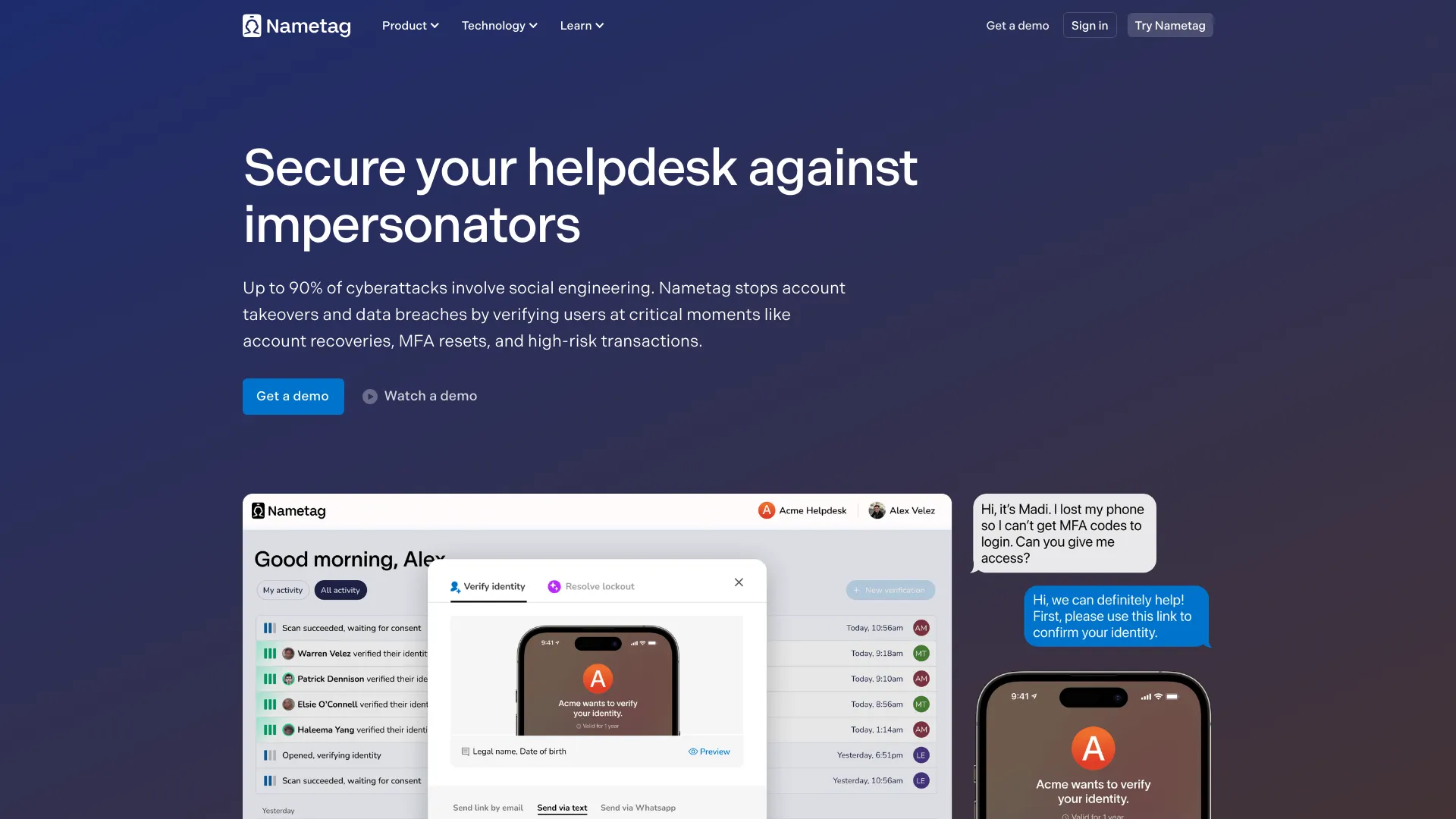
Nametag is best understood as an identity assurance layer for moments where a normal login or support script is not enough. The product focuses on workforce and customer identity verification for account recovery, MFA reset, onboarding, helpdesk verification, and high-risk support workflows.
This is a different category from a generic authentication app. Nametag's public product pages emphasize deepfake-resistant verification, cryptographic attestation, biometrics, adaptive document checks, selfie reverification, and support-agent workflows. The strongest use case is reducing the risk of social engineering when a person asks a helpdesk or automated flow to restore account access.
Best-fit use cases
| Use case | Nametag fit | Notes | |---|---:|---| | Helpdesk identity verification | High | Useful when agents need proof before resetting MFA or passwords. | | Self-service account recovery | High | Strong fit for locked-out employee or customer recovery flows. | | Hiring and onboarding checks | Medium to high | Relevant where remote identity fraud is a concern. | | Agentic AI security | Medium | Useful for step-up verification around sensitive AI-assisted actions. | | Low-risk consumer login | Low | Too heavy if a product only needs basic MFA. |
Strengths
- Purpose-built for social engineering and deepfake risk around account recovery.
- Fits both agent-assisted helpdesk flows and self-service verification flows.
- Public materials emphasize privacy, SOC 2, CCPA, HIPAA, and user control.
- Integrations with workflows such as ServiceNow and Zendesk make it operationally practical.
Limitations
- Buyers still need clear policies for when verification is required and who can override it.
- Identity verification can add friction if used on low-risk actions.
- Enterprise value depends on integration quality with IAM, helpdesk, HR, and customer systems.
- Security claims should be validated with vendor documentation, threat modeling, and procurement review.
TakeAI verdict
Nametag is a strong candidate for teams worried about helpdesk social engineering, deepfakes, and account takeover during recovery. It should not be treated as a cosmetic verification badge. The right rollout maps high-risk account actions, defines step-up triggers, tests helpdesk workflows, and measures both fraud reduction and legitimate user completion time.
Sources reviewed: Nametag identity verification, Nametag helpdesk verification, Nametag human identity verification.
FAQ
What is Nametag best for?
Nametag is best for verifying a real person before high-risk actions such as password reset, MFA reset, onboarding, or helpdesk-assisted account recovery.
Does Nametag replace MFA?
No. It is better viewed as a step-up identity verification layer for moments when MFA is missing, reset, bypassed, or being recovered.
Who should evaluate Nametag?
Security, IT, IAM, and support leaders at organizations exposed to helpdesk fraud, employee account takeover, remote onboarding risk, or deepfake impersonation.