Inworld
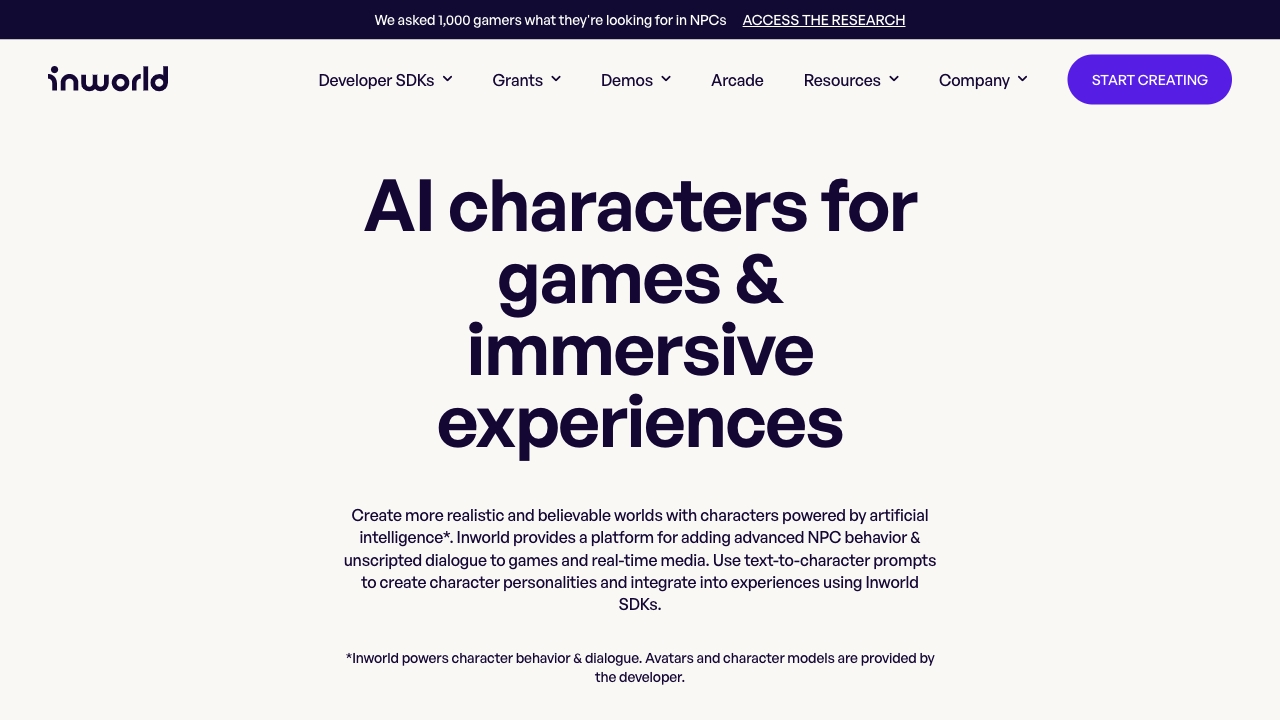
Inworld: The AI Engine for Immersive In-Game Characters Inworld is an innovative AI engine designed to create immersive in-game characters that exhibit lifelike behavior. By leveraging advanced artificial intelligence, Inworld enables game developers to craft characters that not only respond intelligently to player actions but also engage in realistic interactions, enhancing the overall gaming experience. Key Features of Inworld: - **Lifelike Behavior**: Characters powered by Inworld demonstrate behaviors that mimic real-life interactions, making gameplay more engaging and believable. - **Immersive Experiences**: With Inworld, players can enjoy a deeper level of immersion as characters react dynamically to their choices and actions. - **Easy Integration**: Inworld's AI engine can be seamlessly integrated into existing game frameworks, allowing developers to enhance their games without extensive overhauls. By utilizing Inworld, game developers can elevate their projects, creating memorable characters that resonate with players and keep them coming back for more. Experience the future of gaming with Inworld's cutting-edge technology.
AI Project Details
Inworld review: AI character and gameplay infrastructure for interactive worlds
Inworld is an AI engine for interactive characters, game mechanics, and real-time player experiences. Its current positioning is broader than a simple NPC chatbot: the platform focuses on runtime character behavior, game-aware agents, narrative interaction, speech, memory, and production integrations for studios building interactive entertainment.
That distinction matters. A website widget can answer questions from a knowledge base. Inworld is aimed at teams that need characters or agents to behave inside a game loop, respond to player state, and stay aligned with creative direction, safety rules, latency constraints, and platform performance.
Best-fit use cases
| Use case | Inworld fit | Notes | |---|---:|---| | AI NPCs and game characters | High | Strong fit when characters need personality, memory, voice, and state-aware behavior. | | Interactive story prototypes | High | Useful for testing dialogue systems and emergent player interactions. | | UGC worlds and social games | Medium to high | Needs moderation, safety design, and runtime cost planning. | | Customer support chatbots | Low | General support-agent tools are usually a better fit. | | Static lore databases | Medium | Inworld is more valuable when lore becomes behavior, not just searchable text. |
What to evaluate before adopting Inworld
Studios should test Inworld with real gameplay constraints rather than a standalone chat demo. Useful pilot metrics include response latency, character consistency, safety behavior, authoring workflow, engine integration effort, fallback behavior, token/runtime cost, multilingual needs, and whether designers can iterate without depending on engineers for every change.
Creative control is the main adoption question. If character dialogue must follow a strict script, traditional branching dialogue tools may still be better. If the experience benefits from dynamic player conversation, contextual behavior, or agent-like reactions, Inworld becomes more compelling.
Strengths
- Focused on interactive characters and game worlds, not generic chat.
- Good fit for AI NPCs, world agents, companion characters, and narrative prototypes.
- Supports a stronger production conversation around latency, behavior, guardrails, and integration.
Limitations
- Requires design, writing, safety, and engineering work; it is not a one-click NPC system.
- Runtime cost and latency need to be tested under real traffic.
- Studios still need human narrative direction, QA, moderation rules, and fallback design.
Bottom line
Inworld deserves an indexable TakeAI page because it has clear search intent around AI NPCs and interactive characters. The best pilot is one real scene: define a character, connect game state, run playtests, measure latency and quality, and decide whether dynamic interaction improves the player experience enough to justify production complexity.
Sources reviewed: Inworld homepage, Inworld pricing, Inworld AI NPC development.
FAQ
What is Inworld best for?
Inworld is best for AI NPCs, interactive game characters, dynamic story prototypes, and real-time agents that need to respond inside game or virtual-world experiences.
Is Inworld just a chatbot for games?
No. Inworld is closer to character infrastructure for interactive worlds, where personality, context, runtime behavior, latency, and guardrails matter.
What should a studio test before using Inworld?
Test response latency, character consistency, safety behavior, engine integration, authoring workflow, fallback handling, runtime cost, and whether players prefer the dynamic interaction.