Mirage
Unified virtual filesystem for AI agents that mounts services and data sources into one bash-addressable workspace with snapshots, cloning, and caching.
AI Project Details
Mirage review: Unified virtual filesystem for AI agents that mounts services and data sources into one bash-addressable workspace with snapshots, cloning, and caching.
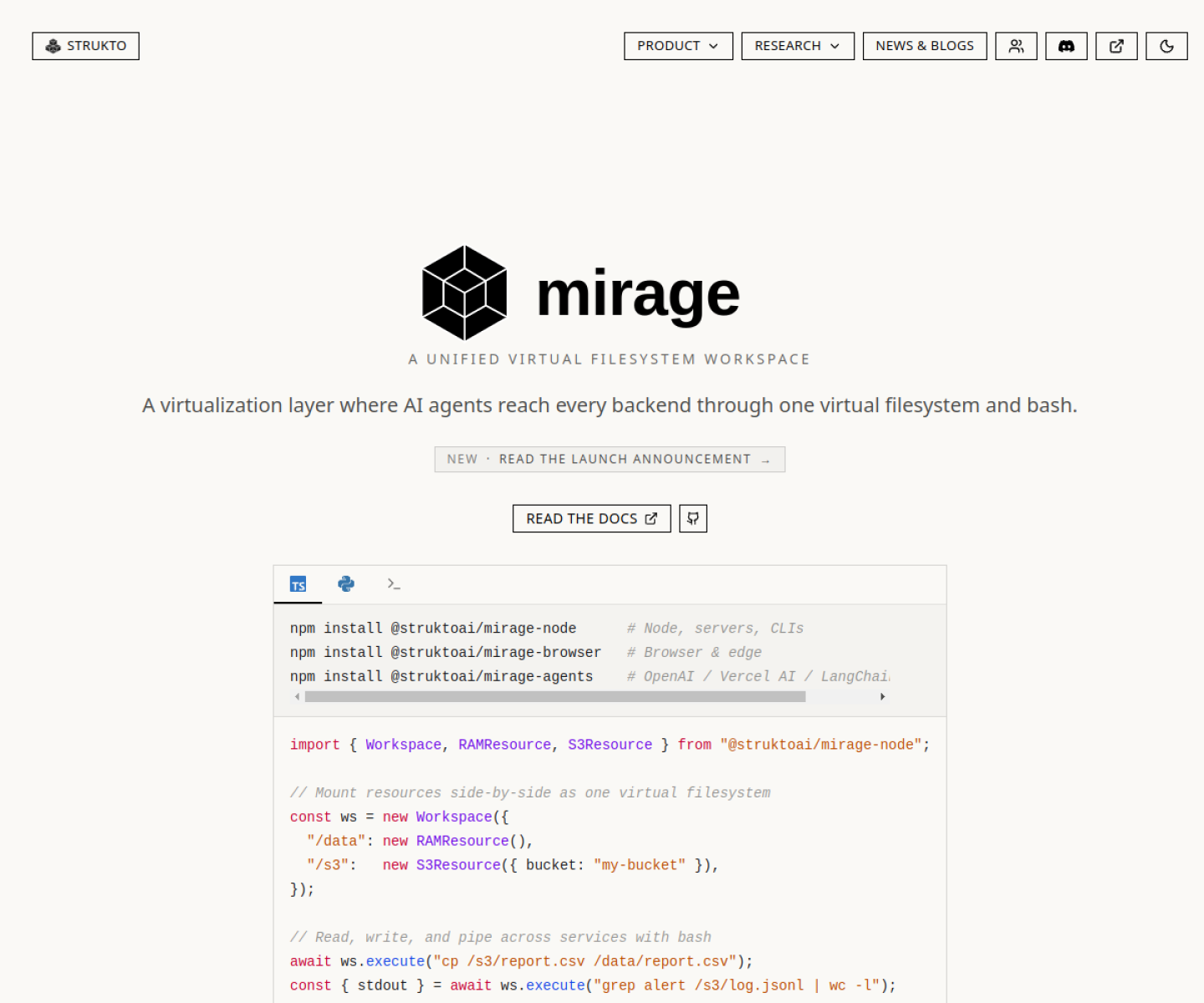
Mirage stands out because it is not just another chat shell. The product materials describe a system centered on mount resources such as s3, github, slack, or cloud storage into a mirage workspace, let the agent read and write through one filesystem and bash layer, then snapshot or clone that workspace as the run evolves. That matters because the mechanism is the product, not a thin wrapper around a frontier model.
Why the architecture matters
Mirage solves a real agent ergonomics problem by turning mixed backends into one filesystem instead of another connector registry. The official site is concrete about mechanics like bash over multiple formats, piping across systems, snapshotting, and caching. It is easier to reason about than vague agent-platform claims because the underlying abstraction is explicit and testable.
How to evaluate the core loop
Start by testing the narrowest real workflow the product claims to improve. For Mirage, that means users should mount resources such as s3, github, slack, or cloud storage into a mirage workspace, let the agent read and write through one filesystem and bash layer, then snapshot or clone that workspace as the run evolves. The result should be easier to inspect, integrate, or control than a direct agent session.
Where it stands out
| Evaluation angle | Fit | Why it matters | | --- | --- | --- | | Best-fit user | High | Developers building agent systems that need one consistent execution surface across files, object stores, SaaS connectors, and databases. | | Core workflow clarity | High | Mount resources such as S3, GitHub, Slack, or cloud storage into a Mirage workspace, let the agent read and write through one filesystem and bash layer, then snapshot or clone that workspace as the run evolves. | | Switching cost reducer | Medium to high | Mirage solves a real agent ergonomics problem by turning mixed backends into one filesystem instead of another connector registry. | | Adoption risk | Medium | The strongest value appears when agents actually need to move across heterogeneous backends rather than a single local repo. |
Practical use cases
- Giving agents one filesystem across cloud storage, apps, and local resources
- Snapshotting and cloning workspaces during long-running agent tasks
- Running bash-style data workflows across heterogeneous backends
Limits and buying notes
The strongest value appears when agents actually need to move across heterogeneous backends rather than a single local repo. A virtualized workspace simplifies access patterns, but teams still need to verify performance and permission behavior for sensitive systems. Pricing status today: Mirage is documented as an open-source SDK and workspace layer in the reviewed official sources, which did not expose a separate self-serve hosted pricing table.
FAQ
What is Mirage best for?
Mirage is strongest when giving agents one filesystem across cloud storage, apps, and local resources matters more than a generic AI demo. The official product materials position it around a concrete workflow rather than a blank chatbot shell.
Who should try Mirage first?
Developers building agent systems that need one consistent execution surface across files, object stores, SaaS connectors, and databases. Teams with a real workflow match will get value faster than general curiosity users.
What should buyers verify before adopting Mirage?
The strongest value appears when agents actually need to move across heterogeneous backends rather than a single local repo. A virtualized workspace simplifies access patterns, but teams still need to verify performance and permission behavior for sensitive systems. Pricing, privacy, and workflow fit should be checked directly on the current product before rollout.
Reviewed sources
- https://www.strukto.ai/mirage
- https://docs.mirage.strukto.ai/
- https://github.com/strukto-ai/mirage
FAQ
What is Mirage best for?
Mirage is strongest when giving agents one filesystem across cloud storage, apps, and local resources matters more than a generic AI demo. The official product materials position it around a concrete workflow rather than a blank chatbot shell.
Who should try Mirage first?
Developers building agent systems that need one consistent execution surface across files, object stores, SaaS connectors, and databases. Teams with a real workflow match will get value faster than general curiosity users.
What should buyers verify before adopting Mirage?
The strongest value appears when agents actually need to move across heterogeneous backends rather than a single local repo. A virtualized workspace simplifies access patterns, but teams still need to verify performance and permission behavior for sensitive systems. Pricing, privacy, and workflow fit should be checked directly on the current product before rollout.