Model Due Diligence
Static review CLI for AI model files and cloned model repositories before they are imported into local runtimes or agent stacks.
AI Project Details
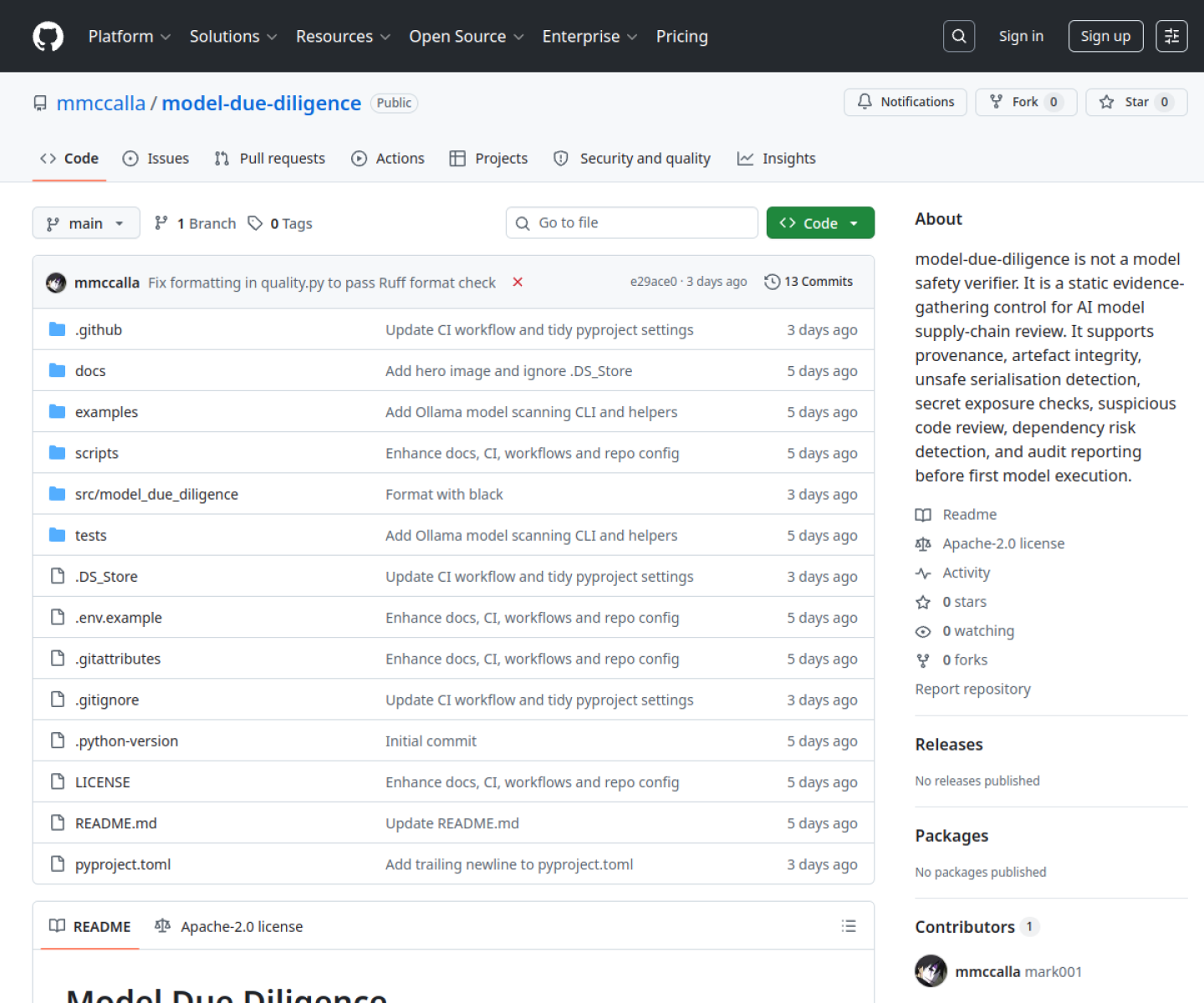
Model Due Diligence review: Static review CLI for AI model files and cloned model repositories before they are imported into local runtimes or agent stacks.
Model Due Diligence stands out because it is not just another chat shell. The product materials describe a system centered on point the cli at a local model directory or cloned repository, run the scan, review the markdown or json report, and use the findings as a risk-reduction gate before the model is loaded into ollama, transformers, or similar runtimes. That matters because the mechanism is the product, not a thin wrapper around a frontier model.
Why the architecture matters
The project is clear that it is doing static evidence gathering, not pretending to certify a model as safe. Its README is strong on concrete scanner coverage such as unsafe serialization detection, provenance checks, suspicious code review, entropy checks, and report outputs. The output formats and SARIF path make it practical for teams that want model-intake checks to become part of a broader engineering workflow.
How to evaluate the core loop
Start by testing the narrowest real workflow the product claims to improve. For Model Due Diligence, that means users should point the cli at a local model directory or cloned repository, run the scan, review the markdown or json report, and use the findings as a risk-reduction gate before the model is loaded into ollama, transformers, or similar runtimes. The result should be easier to inspect, integrate, or control than a direct agent session.
Where it stands out
| Evaluation angle | Fit | Why it matters | | --- | --- | --- | | Best-fit user | High | Developers, security teams, and AI platform operators that need a repeatable preflight check before loading third-party model artifacts. | | Core workflow clarity | High | Point the CLI at a local model directory or cloned repository, run the scan, review the Markdown or JSON report, and use the findings as a risk-reduction gate before the model is loaded into Ollama, Transformers, or similar runtimes. | | Switching cost reducer | Medium to high | The project is clear that it is doing static evidence gathering, not pretending to certify a model as safe. | | Adoption risk | Medium | The tool cannot prove model safety or catch behavior that only appears at runtime, during fine-tuning, or after tool connections are added. |
Practical use cases
- Checking model repositories before loading them into Ollama or llama.cpp
- Adding a static model-intake gate to AI platform workflows
- Producing reviewable evidence for security and compliance teams
Limits and buying notes
The tool cannot prove model safety or catch behavior that only appears at runtime, during fine-tuning, or after tool connections are added. The strongest fit is for teams that already manage local model artifacts and need an intake gate, not for casual chat users. Pricing status today: Model Due Diligence is presented as an open-source Python CLI project and the reviewed public sources did not show a separate commercial pricing page.
FAQ
What is Model Due Diligence best for?
Model Due Diligence is strongest when checking model repositories before loading them into ollama or llama.cpp matters more than a generic AI demo. The official product materials position it around a concrete workflow rather than a blank chatbot shell.
Who should try Model Due Diligence first?
Developers, security teams, and AI platform operators that need a repeatable preflight check before loading third-party model artifacts. Teams with a real workflow match will get value faster than general curiosity users.
What should buyers verify before adopting Model Due Diligence?
The tool cannot prove model safety or catch behavior that only appears at runtime, during fine-tuning, or after tool connections are added. The strongest fit is for teams that already manage local model artifacts and need an intake gate, not for casual chat users. Pricing, privacy, and workflow fit should be checked directly on the current product before rollout.
Reviewed sources
- https://github.com/mmccalla/model-due-diligence
- https://raw.githubusercontent.com/mmccalla/model-due-diligence/main/README.md
- https://news.ycombinator.com/item?id=48515575
FAQ
What is Model Due Diligence best for?
Model Due Diligence is strongest when checking model repositories before loading them into ollama or llama.cpp matters more than a generic AI demo. The official product materials position it around a concrete workflow rather than a blank chatbot shell.
Who should try Model Due Diligence first?
Developers, security teams, and AI platform operators that need a repeatable preflight check before loading third-party model artifacts. Teams with a real workflow match will get value faster than general curiosity users.
What should buyers verify before adopting Model Due Diligence?
The tool cannot prove model safety or catch behavior that only appears at runtime, during fine-tuning, or after tool connections are added. The strongest fit is for teams that already manage local model artifacts and need an intake gate, not for casual chat users. Pricing, privacy, and workflow fit should be checked directly on the current product before rollout.