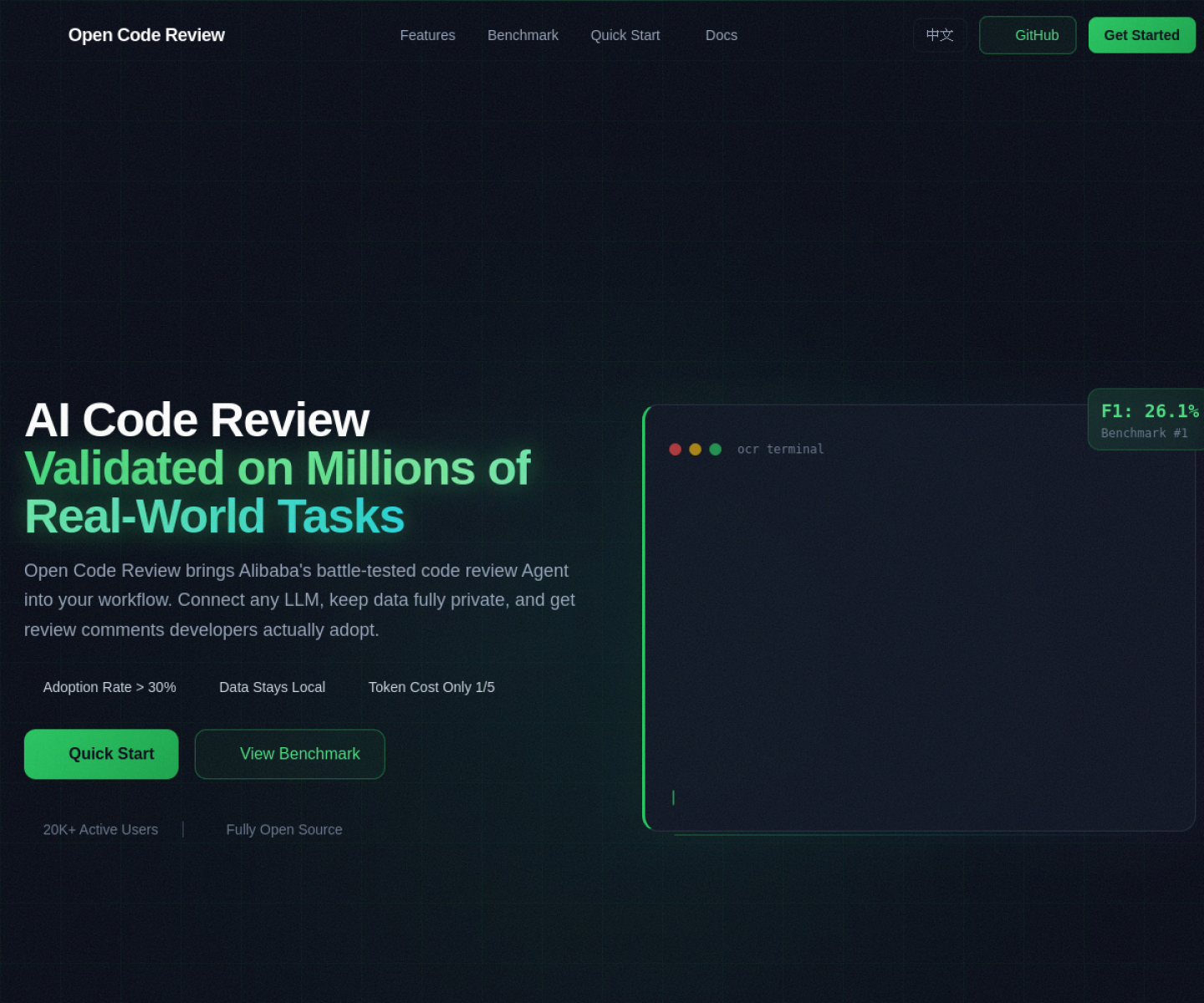
Open Code Review
Hybrid code-review tool that combines deterministic rules with an LLM agent to produce line-level feedback on bugs, security issues, and maintainability risks.
AI Project Details
Open Code Review review: Hybrid code-review tool that combines deterministic rules with an LLM agent to produce line-level feedback on bugs, security issues, and maintainability risks.
Open Code Review is aimed at engineering teams that want stronger automated review than a generic pr summary bot, especially where security and concurrency issues matter. The current product materials describe a workflow built around connect the tool to the review surface, run it on code changes, and inspect the mix of deterministic findings and agent-generated comments before merge. That makes the page easier to read as an operating model, not just a brand claim.
Why it is timely
The project is clear that it is not only an LLM wrapper: deterministic rules remain part of the architecture. Alibaba's positioning around line-level comments and battle-tested internal usage gives the tool more credibility than many generic review bots. The hybrid design matters because it can blend inspectable rules with broader cross-file reasoning instead of forcing one approach alone.
How the workflow works in practice
A sensible first pass is to start from the product's main entry point and test the shortest path to value. For Open Code Review, that means users should connect the tool to the review surface, run it on code changes, and inspect the mix of deterministic findings and agent-generated comments before merge. If that loop reduces review drag, coordination, or governance work, the product is doing something real.
Where Open Code Review stands out
| Evaluation angle | Fit | Why it matters | | --- | --- | --- | | Best-fit user | High | Engineering teams that want stronger automated review than a generic PR summary bot, especially where security and concurrency issues matter. | | Core workflow clarity | High | Connect the tool to the review surface, run it on code changes, and inspect the mix of deterministic findings and agent-generated comments before merge. | | Switching cost reducer | Medium to high | The project is clear that it is not only an LLM wrapper: deterministic rules remain part of the architecture. | | Adoption risk | Medium | Teams still need to benchmark false positives, review noise, and language support on their own repositories before adopting it widely. |
Practical use cases
- Adding automated code review with deterministic and agent-driven checks
- Catching security and correctness issues earlier in pull requests
- Giving teams more detailed review output than a simple PR summary
Limits and buying notes
Teams still need to benchmark false positives, review noise, and language support on their own repositories before adopting it widely. The tool is only worthwhile if it reduces review effort without creating a second queue of low-value comments. Pricing status today: Alibaba presents Open Code Review as an open-source project, and the reviewed public pages did not show a separate commercial pricing plan.
FAQ
What is Open Code Review best for?
Open Code Review is strongest when adding automated code review with deterministic and agent-driven checks matters more than a generic AI demo. The official product materials position it around a concrete workflow rather than a blank chatbot shell.
Who should try Open Code Review first?
Engineering teams that want stronger automated review than a generic PR summary bot, especially where security and concurrency issues matter. Teams with a real workflow match will get value faster than general curiosity users.
What should buyers verify before adopting Open Code Review?
Teams still need to benchmark false positives, review noise, and language support on their own repositories before adopting it widely. The tool is only worthwhile if it reduces review effort without creating a second queue of low-value comments. Pricing, privacy, and workflow fit should be checked directly on the current product before rollout.
Reviewed sources
- https://alibaba.github.io/open-code-review/
- https://github.com/alibaba/open-code-review
FAQ
What is Open Code Review best for?
Open Code Review is strongest when adding automated code review with deterministic and agent-driven checks matters more than a generic AI demo. The official product materials position it around a concrete workflow rather than a blank chatbot shell.
Who should try Open Code Review first?
Engineering teams that want stronger automated review than a generic PR summary bot, especially where security and concurrency issues matter. Teams with a real workflow match will get value faster than general curiosity users.
What should buyers verify before adopting Open Code Review?
Teams still need to benchmark false positives, review noise, and language support on their own repositories before adopting it widely. The tool is only worthwhile if it reduces review effort without creating a second queue of low-value comments. Pricing, privacy, and workflow fit should be checked directly on the current product before rollout.