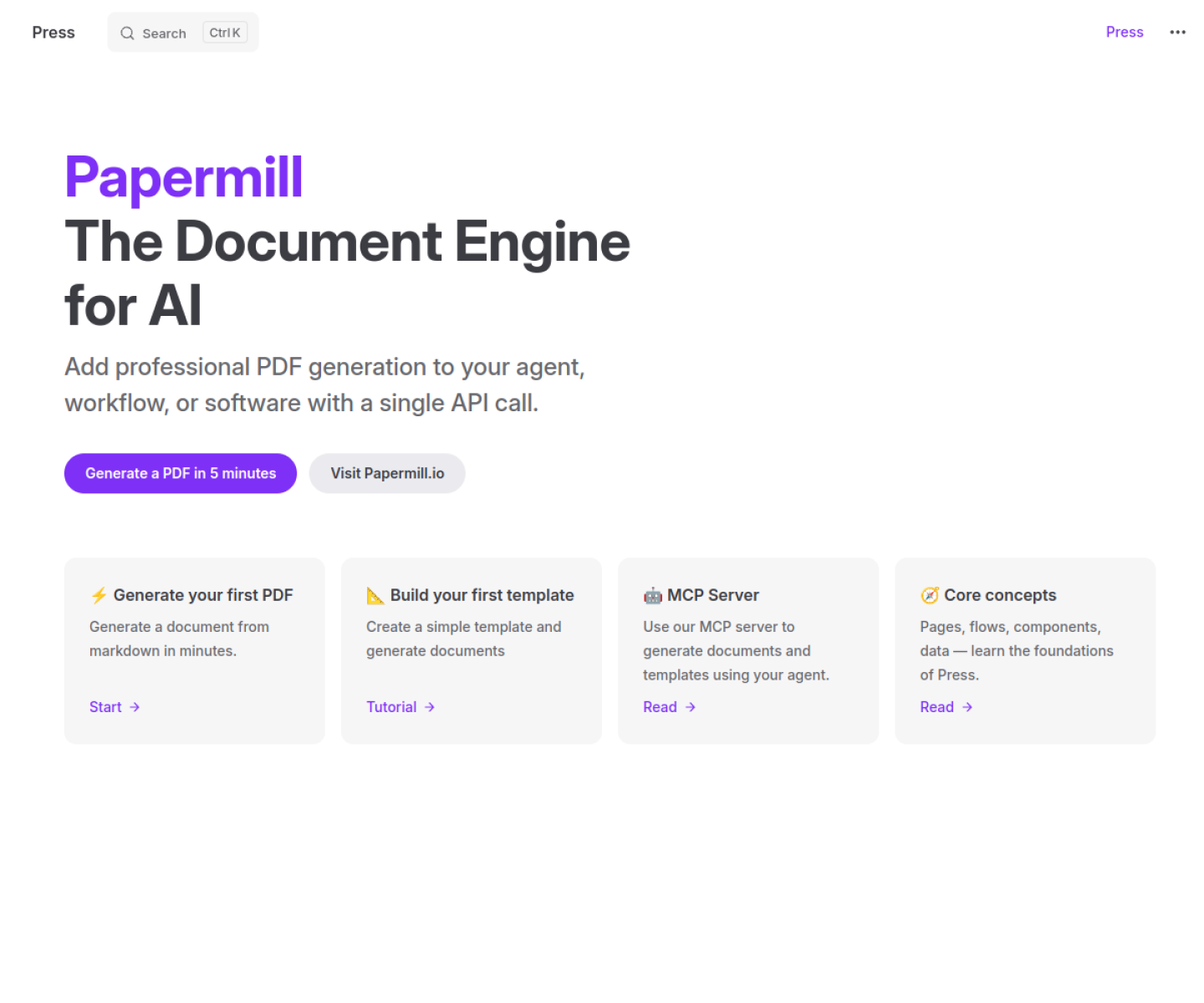
Papermill Press
Print-native document engine and markup language for generating production-ready PDFs from markdown, JSON, and XML without fighting browser-first HTML layout.
AI Project Details
Papermill Press review: Print-native document engine and markup language for generating production-ready PDFs from markdown, JSON, and XML without fighting browser-first HTML layout.
Papermill Press stands out because it is not just another chat shell. The product materials describe a system centered on design a press template, send markdown or structured data to the api, let the engine flow content into the layout automatically, and return a production-ready pdf. That matters because the mechanism is the product, not a thin wrapper around a frontier model.
Why the architecture matters
Papermill attacks a real pain point: HTML was built for screens, not for repeatable print layout. The docs and launch post are concrete about page flows, frames, template logic, data inputs, and MCP-assisted template design. Its document-language approach is more inspectable and automation-friendly than another stack of print CSS workarounds.
How to evaluate the core loop
Start by testing the narrowest real workflow the product claims to improve. For Papermill Press, that means users should design a press template, send markdown or structured data to the api, let the engine flow content into the layout automatically, and return a production-ready pdf. The result should be easier to inspect, integrate, or control than a direct agent session.
Where it stands out
| Evaluation angle | Fit | Why it matters | | --- | --- | --- | | Best-fit user | High | Developers and agent builders who need reliable generated documents, reports, or templates instead of brittle HTML-to-PDF workflows. | | Core workflow clarity | High | Design a Press template, send markdown or structured data to the API, let the engine flow content into the layout automatically, and return a production-ready PDF. | | Switching cost reducer | Medium to high | Papermill attacks a real pain point: HTML was built for screens, not for repeatable print layout. | | Adoption risk | Medium | Teams need to decide whether learning a dedicated document language is worth it compared with accepting rougher HTML-to-PDF output. |
Practical use cases
- Generating reliable PDFs from markdown or structured data for AI workflows
- Building reusable document templates with content-aware page flows
- Replacing fragile HTML-to-PDF rendering in report and proposal pipelines
Limits and buying notes
Teams need to decide whether learning a dedicated document language is worth it compared with accepting rougher HTML-to-PDF output. The strongest value appears in recurring document generation pipelines, not in rare one-off exports. Pricing status today: Papermill describes itself as a paid API with a free tier, and the reviewed public pages also expose a no-card signup flow and demo sandbox.
FAQ
What is Papermill Press best for?
Papermill Press is strongest when generating reliable pdfs from markdown or structured data for ai workflows matters more than a generic AI demo. The official product materials position it around a concrete workflow rather than a blank chatbot shell.
Who should try Papermill Press first?
Developers and agent builders who need reliable generated documents, reports, or templates instead of brittle HTML-to-PDF workflows. Teams with a real workflow match will get value faster than general curiosity users.
What should buyers verify before adopting Papermill Press?
Teams need to decide whether learning a dedicated document language is worth it compared with accepting rougher HTML-to-PDF output. The strongest value appears in recurring document generation pipelines, not in rare one-off exports. Pricing, privacy, and workflow fit should be checked directly on the current product before rollout.
Reviewed sources
- https://docs.papermill.io/
- https://app.papermill.io/signup
- https://news.ycombinator.com/item?id=48477708
FAQ
What is Papermill Press best for?
Papermill Press is strongest when generating reliable pdfs from markdown or structured data for ai workflows matters more than a generic AI demo. The official product materials position it around a concrete workflow rather than a blank chatbot shell.
Who should try Papermill Press first?
Developers and agent builders who need reliable generated documents, reports, or templates instead of brittle HTML-to-PDF workflows. Teams with a real workflow match will get value faster than general curiosity users.
What should buyers verify before adopting Papermill Press?
Teams need to decide whether learning a dedicated document language is worth it compared with accepting rougher HTML-to-PDF output. The strongest value appears in recurring document generation pipelines, not in rare one-off exports. Pricing, privacy, and workflow fit should be checked directly on the current product before rollout.