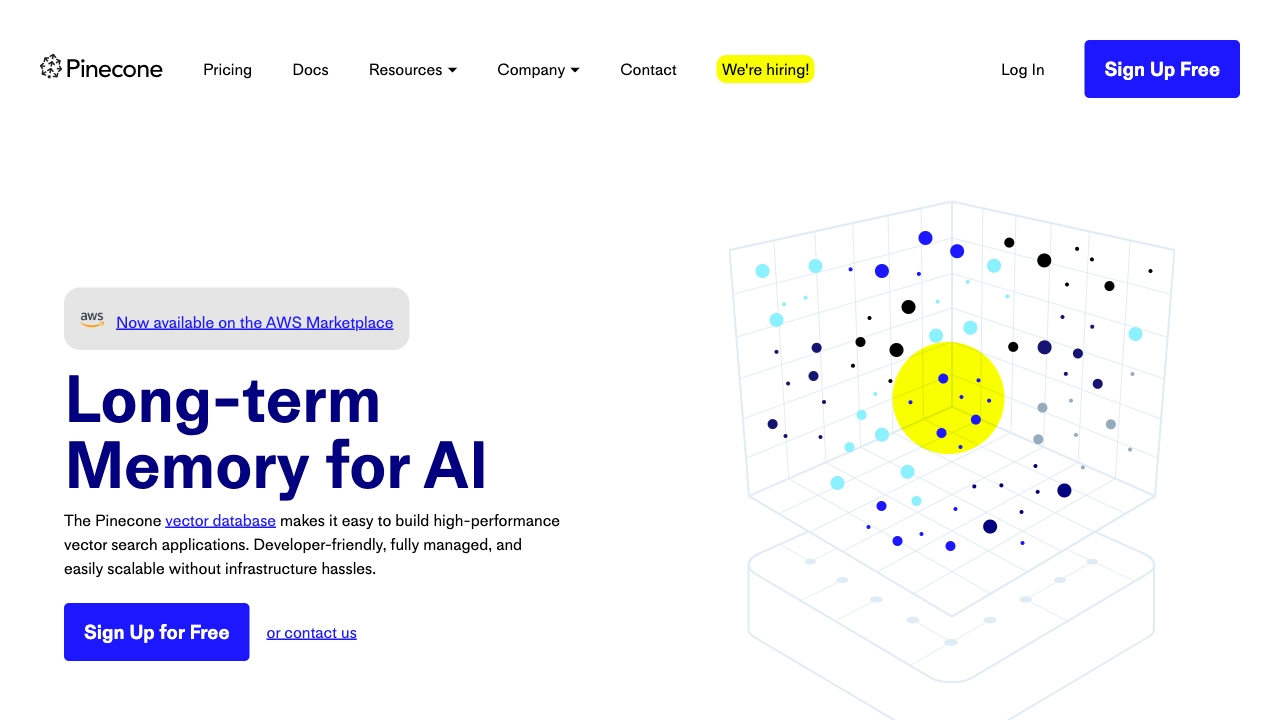
Pinecone
Pinecone: The Fast Vector Database for Instant Similarity Searches In today's fast-paced digital world, finding similar items quickly is essential. Pinecone is a cutting-edge vector database designed to perform similarity searches in milliseconds. Whether you're looking for related products, images, or any other type of data, Pinecone delivers results at lightning speed. Why Choose Pinecone? 1. **Speed**: Pinecone's advanced architecture allows for rapid searches, ensuring you get the information you need without delay. 2. **Scalability**: As your data grows, Pinecone scales effortlessly, handling millions of vectors with ease. 3. **Ease of Use**: With a user-friendly interface, integrating Pinecone into your existing systems is straightforward, making it accessible for developers and businesses alike. Key Features of Pinecone - **Real-Time Search**: Experience instant results with minimal latency. - **High Accuracy**: Pinecone utilizes sophisticated algorithms to ensure that the most relevant items are returned. - **Flexible Integration**: Easily connect Pinecone with your applications and workflows. In conclusion, if you're in need of a reliable and efficient solution for similarity searches, Pinecone is the answer. Its speed, scalability, and user-friendly design make it the ideal choice for businesses looking to enhance their data search capabilities. Discover the power of Pinecone today and transform the way you find similar items!
AI Project Details
Pinecone review: vector database infrastructure for RAG and AI search
Pinecone is a managed vector database for semantic search, hybrid search, recommendations, retrieval-augmented generation, and AI agents. Its official docs describe dense, sparse, and full-text indexes, integrated embedding and reranking, namespaces for multitenant isolation, serverless architecture, imports from object storage, backups, SDKs, and API tooling. Pinecone's pricing pages position it around serverless pay-per-request usage, Pinecone Inference, Pinecone Assistant, dense/sparse/full-text indexes, and workload-based cost estimation.
The strongest fit is production retrieval. Many teams can prototype RAG with a local vector store or a Postgres extension. Pinecone becomes more interesting when retrieval is customer-facing, high-volume, multitenant, latency-sensitive, and likely to need operational controls that a simple prototype does not have.
Best-fit use cases
| Use case | Pinecone fit | Notes | |---|---:|---| | Production RAG applications | High | Strong fit when retrieval quality, latency, scaling, and uptime matter. | | Semantic and hybrid search | High | Dense, sparse, and full-text options help combine meaning and keywords. | | Multitenant AI products | Medium to high | Namespaces and managed operations are useful for SaaS workloads. | | Large imports and high-QPS retrieval | Medium to high | Bulk import and serverless architecture matter as data grows. | | Small prototypes | Medium | Simpler local or database-native options may be enough. |
What to evaluate before adopting Pinecone
The key evaluation is not "does vector search work?" It is whether Pinecone improves the full retrieval system. Teams should benchmark chunking, embedding model, hybrid search, reranking, metadata filters, namespace strategy, import process, query latency, read/write units, and total cost per answered question. A RAG system can fail because of poor source documents, bad chunking, weak evals, or hallucinated answer generation even when the vector database is solid.
Strengths
- Purpose-built managed vector database for AI search and RAG.
- Supports semantic, sparse, hybrid, and full-text retrieval patterns.
- Integrated inference and reranking can simplify retrieval pipelines.
- Serverless architecture and object-storage-backed design reduce infrastructure burden.
Limitations
- Cost depends on storage, read/write patterns, inference use, reranking, and query volume.
- A vector database alone does not solve source quality, chunking, evals, or answer grounding.
- Teams should compare Pinecone against pgvector, Qdrant, Weaviate, Elasticsearch, OpenSearch, and cloud-native options.
- Production use still needs monitoring, relevance testing, privacy review, and data lifecycle rules.
TakeAI verdict
Pinecone is a strong indexable page for developers building serious RAG or AI search systems. The right pilot should load a representative corpus, test hybrid retrieval and reranking, measure answer quality with evals, and estimate cost under realistic traffic instead of judging from a small demo.
Sources reviewed: Pinecone docs, Pinecone serverless architecture, Pinecone indexing overview, Pinecone pricing.
FAQ
What is Pinecone best for?
Pinecone is best for production vector search, semantic search, hybrid search, RAG applications, AI agents, recommendations, and multitenant retrieval systems.
Does Pinecone automatically make RAG accurate?
No. Pinecone can provide retrieval infrastructure, but RAG accuracy still depends on source quality, chunking, embeddings, filters, reranking, prompts, and evaluation.
What should developers test before adopting Pinecone?
Test retrieval quality, latency, namespace design, metadata filters, import process, read/write costs, inference costs, reranking, monitoring, and privacy requirements.