Router One
OpenAI-compatible and Anthropic-compatible gateway for routing Claude, GPT, Gemini, and other model calls with provider fallback, request traces, and multiple payment rails.
AI Project Details
Router One review: OpenAI-compatible and Anthropic-compatible gateway for routing Claude, GPT, Gemini, and other model calls with provider fallback, request traces, and multiple payment rails.
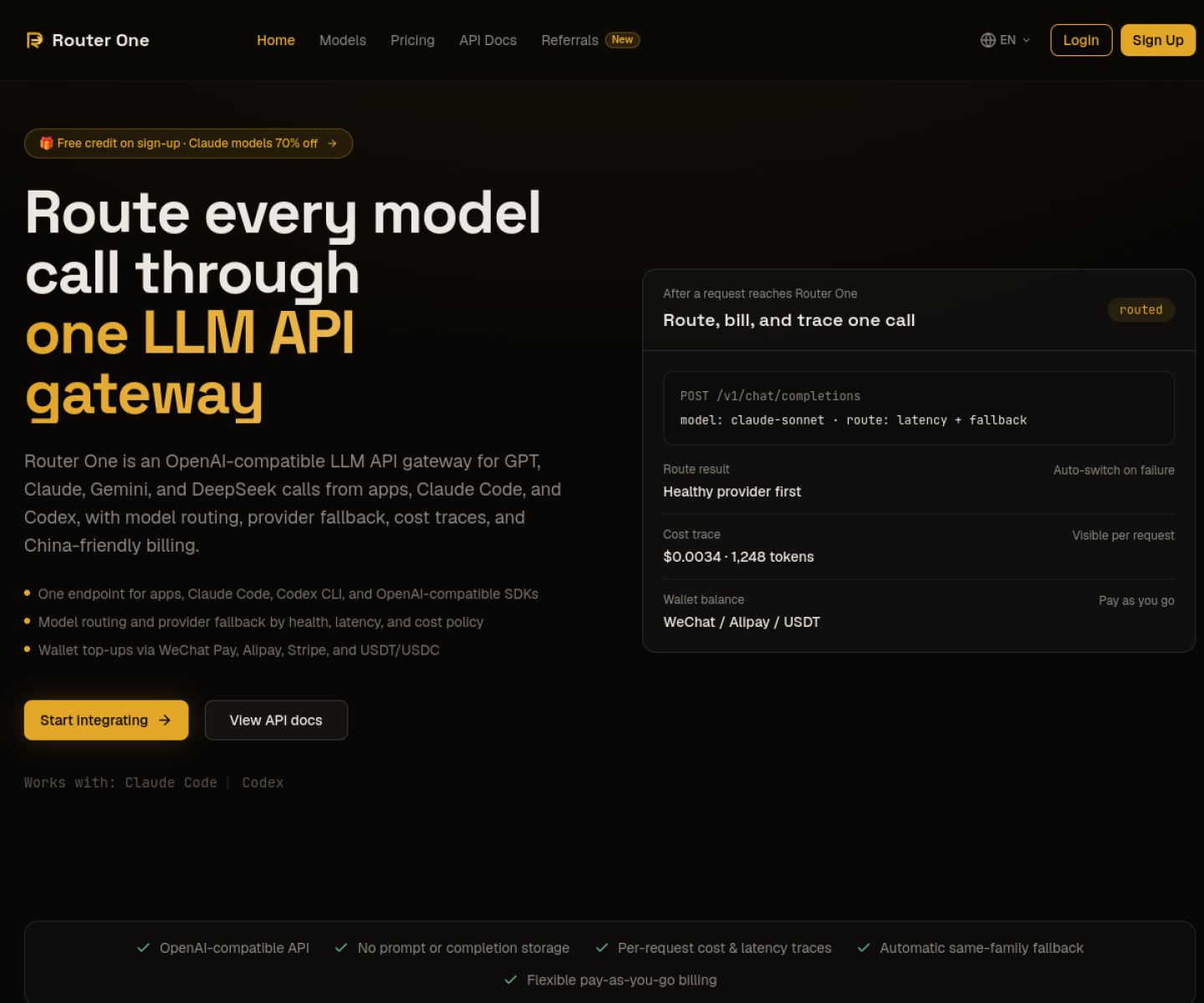
Router One stands out because it is not just another chat shell. The product materials describe a system centered on point a compatible app or coding agent at router one's endpoint, let the gateway choose providers by health, latency, and cost policy, and inspect token and cost traces per request. That matters because the mechanism is the product, not a thin wrapper around a frontier model.
Why the architecture matters
Router One is explicit about supporting both app traffic and coding-agent traffic through one layer rather than focusing only on generic API aggregation. The product is unusually practical for teams that need WeChat Pay, Alipay, or stablecoin top-ups instead of assuming every buyer has a standard US card flow. Its homepage and model catalog expose routing, trace, and billing concepts clearly enough to evaluate operational fit from the public site.
How to evaluate the core loop
Start by testing the narrowest real workflow the product claims to improve. For Router One, that means users should point a compatible app or coding agent at router one's endpoint, let the gateway choose providers by health, latency, and cost policy, and inspect token and cost traces per request. The result should be easier to inspect, integrate, or control than a direct agent session.
Where it stands out
| Evaluation angle | Fit | Why it matters | | --- | --- | --- | | Best-fit user | High | Teams that want one gateway for apps, Claude Code, and Codex while keeping routing, billing, and observability in one place. | | Core workflow clarity | High | Point a compatible app or coding agent at Router One's endpoint, let the gateway choose providers by health, latency, and cost policy, and inspect token and cost traces per request. | | Switching cost reducer | Medium to high | Router One is explicit about supporting both app traffic and coding-agent traffic through one layer rather than focusing only on generic API aggregation. | | Adoption risk | Medium | The product still adds a gateway dependency, so teams need to decide whether the billing and routing convenience outweigh the extra layer. |
Practical use cases
- Routing Claude Code and Codex traffic through one LLM gateway
- Adding request-level token and cost traces to model usage
- Paying for multi-provider LLM access through wallet-style billing
Limits and buying notes
The product still adds a gateway dependency, so teams need to decide whether the billing and routing convenience outweigh the extra layer. The China-first payment and access posture is valuable for some buyers but less relevant for teams that already have a settled billing path elsewhere. Pricing status today: Router One's official pricing page says customers can choose Pro, Max, or Ultra subscriptions or use wallet-style pay-as-you-go billing, but the crawl did not expose exact plan amounts on the page.
FAQ
What is Router One best for?
Router One is strongest when routing claude code and codex traffic through one llm gateway matters more than a generic AI demo. The official product materials position it around a concrete workflow rather than a blank chatbot shell.
Who should try Router One first?
Teams that want one gateway for apps, Claude Code, and Codex while keeping routing, billing, and observability in one place. Teams with a real workflow match will get value faster than general curiosity users.
What should buyers verify before adopting Router One?
The product still adds a gateway dependency, so teams need to decide whether the billing and routing convenience outweigh the extra layer. The China-first payment and access posture is valuable for some buyers but less relevant for teams that already have a settled billing path elsewhere. Pricing, privacy, and workflow fit should be checked directly on the current product before rollout.
Reviewed sources
- https://router.one/
- https://router.one/pricing
- https://router.one/models
FAQ
What is Router One best for?
Router One is strongest when routing claude code and codex traffic through one llm gateway matters more than a generic AI demo. The official product materials position it around a concrete workflow rather than a blank chatbot shell.
Who should try Router One first?
Teams that want one gateway for apps, Claude Code, and Codex while keeping routing, billing, and observability in one place. Teams with a real workflow match will get value faster than general curiosity users.
What should buyers verify before adopting Router One?
The product still adds a gateway dependency, so teams need to decide whether the billing and routing convenience outweigh the extra layer. The China-first payment and access posture is valuable for some buyers but less relevant for teams that already have a settled billing path elsewhere. Pricing, privacy, and workflow fit should be checked directly on the current product before rollout.