SiteAgent.AI
AI that talks and learns to revolutionize your site
AI Project Details
SiteAgent review: voice AI for Shopify and website product discovery
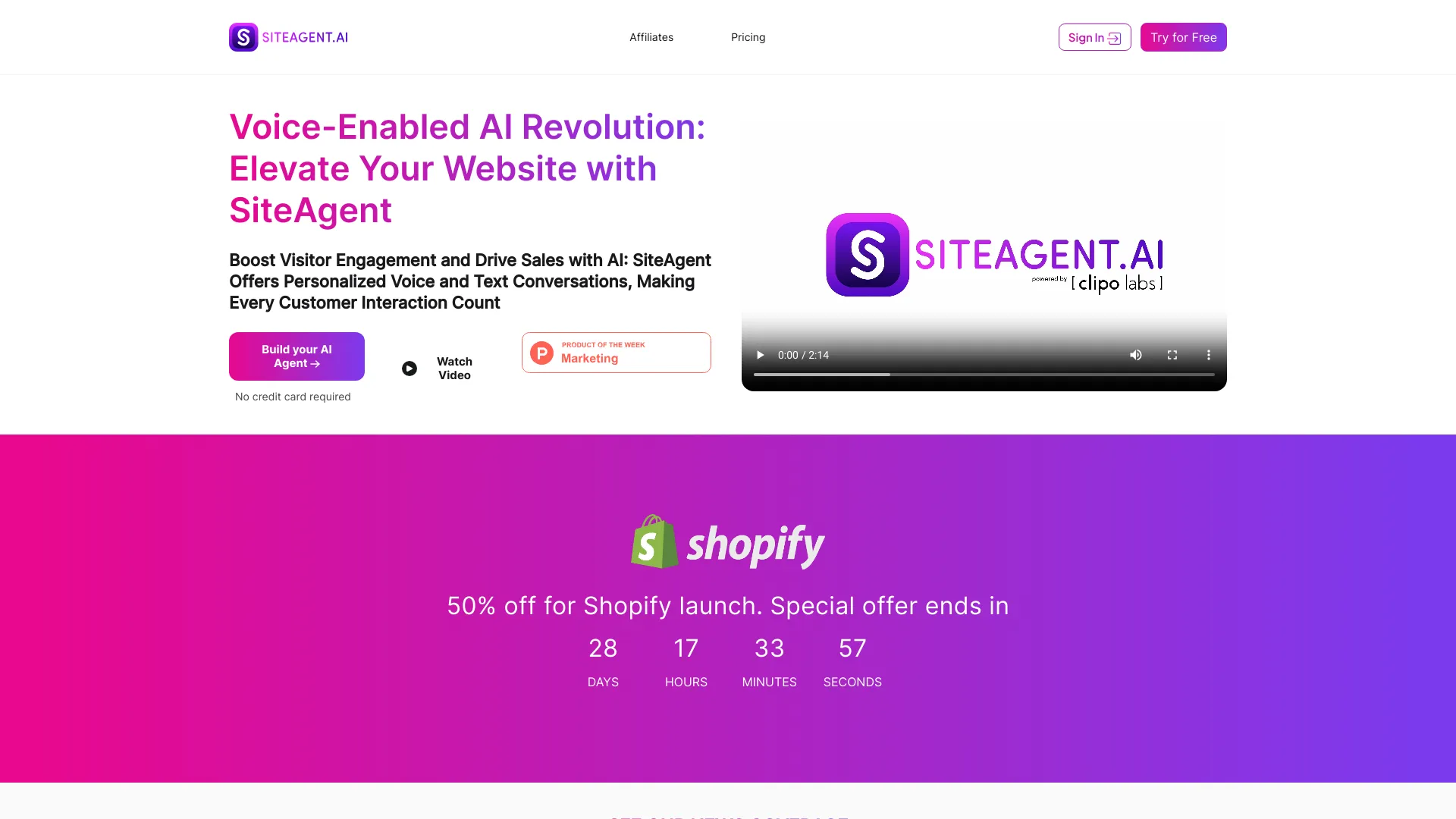
SiteAgent is a voice-enabled AI agent for websites and Shopify stores. The official SiteAgent site describes a no-code AI agent that lets customers ask questions, browse, discover products, get product recommendations, interact in 80+ languages, and receive live voice support. Its Shopify App Store listing adds concrete marketplace context: SiteAgent is listed as a Shopify app by Clipo, Inc., with a free plan, paid message tiers, AI chatbots, voice support, multi-language support, behavior tracking, agent analytics, customer insights, product recommendations, quick replies, upsell, and transcript sending.
The product sits between site search, live chat, and conversion optimization. Instead of asking shoppers to navigate menus or filters, SiteAgent tries to turn product discovery into a conversation.
Best-fit use cases
| Use case | SiteAgent fit | Notes | |---|---:|---| | Shopify product discovery | High | Strong fit when shoppers ask fit, feature, or comparison questions. | | Voice-first store assistance | High | Useful for hands-free or accessibility-friendly browsing. | | Product recommendations | Medium to high | Depends on clean catalog data and recommendation logic. | | Enterprise support replacement | Low to medium | Better for commerce guidance than complex support workflows. | | Stores with sparse product data | Low | AI answers are only as good as the catalog and policies. |
What merchants should verify
Before installing SiteAgent, merchants should test it against real customer questions: sizing, compatibility, delivery, returns, bundles, discounts, out-of-stock scenarios, and product comparisons. A voice agent can increase engagement, but wrong answers about shipping, returns, safety, or pricing can damage trust quickly.
The Shopify listing is especially useful because it exposes pricing tiers, data access categories, and app features. Merchants should review product data permissions, message limits, conversation caps, and whether transcripts fit their privacy policy.
Strengths
- Voice interaction makes product discovery more natural than static FAQ search.
- Shopify App Store listing gives buyers practical details on features, pricing tiers, ratings, and data access.
- Useful for stores where shoppers need product guidance, recommendations, or quick answers before checkout.
- Multi-language support can help international stores reduce browsing friction.
Limitations
- Requires clean product data, policies, and guardrails to avoid incorrect answers.
- Message caps and paid tiers matter for stores with meaningful traffic.
- Voice UI may not fit every brand or every shopper context.
- Merchants must review privacy, transcript, and store-data access implications.
Bottom line
SiteAgent should be indexed as a voice-powered AI shopping assistant for Shopify and commerce websites. Its best use is not generic support deflection; it is helping shoppers ask questions, discover products, and move toward purchase with less navigation friction.
Sources reviewed: SiteAgent homepage, SiteAgent Shopify App Store listing, SiteAgent pricing on Shopify.
FAQ
What is SiteAgent best for?
SiteAgent is best for Shopify and commerce websites that want voice-enabled product discovery, quick product answers, and AI-assisted recommendations.
Does SiteAgent work as a full customer support platform?
It can answer common questions, but its strongest fit is shopping assistance. Complex support, refunds, account issues, and complaints still need human or helpdesk workflows.
What should merchants test before using SiteAgent?
Test product recommendations, return-policy answers, shipping answers, out-of-stock behavior, pricing claims, transcript handling, data access, message limits, and mobile voice usability.