Skwad
Monitor your spending privately - no bank credentials required.
AI Project Details
Skwad review: privacy-first budgeting from bank alerts, receipts, and statements
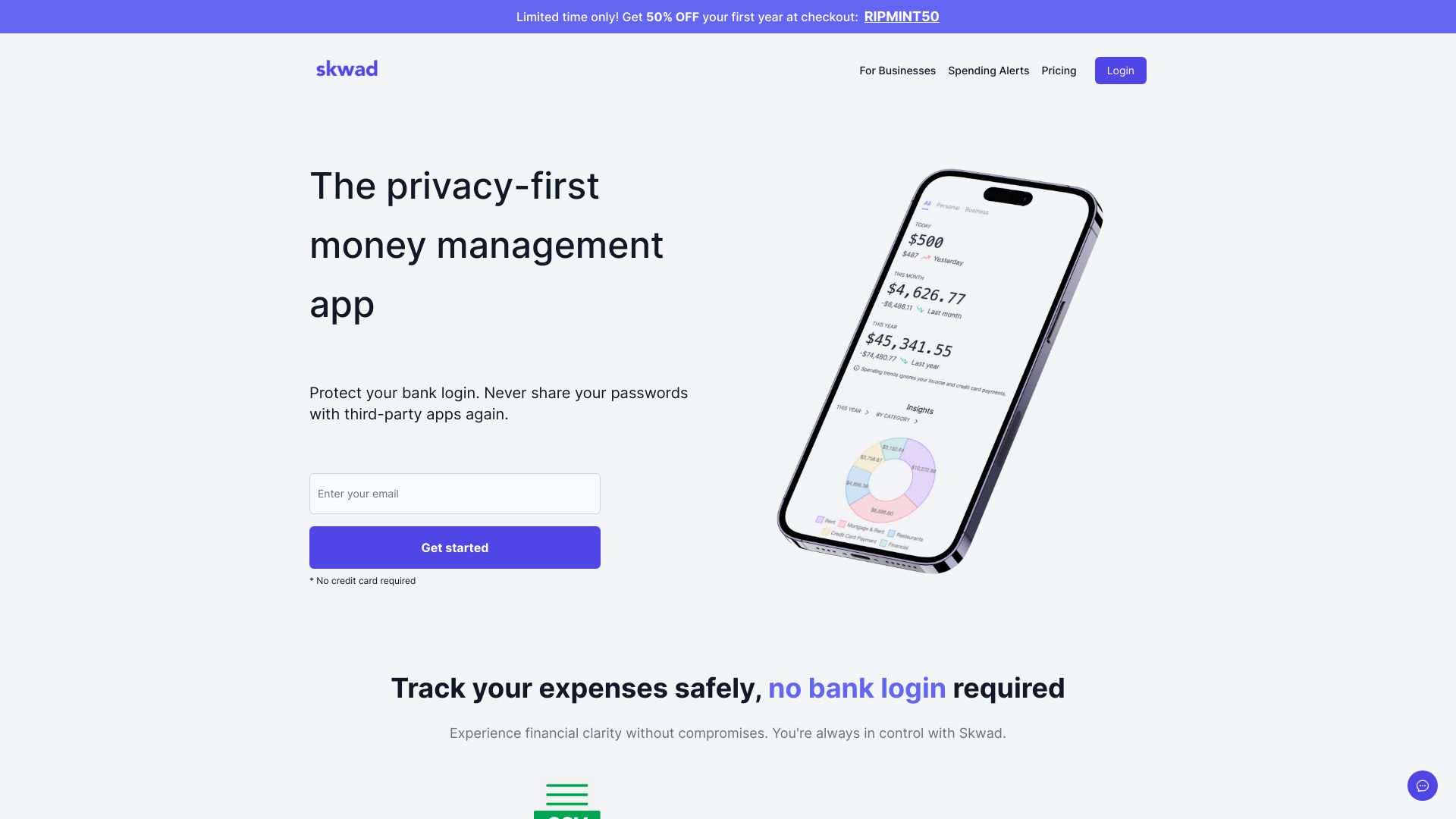
Skwad is a privacy-first budgeting app that helps people understand spending without requiring bank credentials. Its official site describes transaction syncing through bank email alerts, a dedicated Skwad scan email address, automatic transaction categorization, optional Plaid or MX bank linking, receipt scanning, bank statement PDF to Excel conversion, CSV, OFX, and QIF imports, shared budgeting for couples, bill alerts, rules and automations, exports, iPhone and Mac widgets, and AWS-encrypted storage.
The product is not a generic AI finance chatbot. Its distinctive idea is using email alerts and uploaded documents as a lower-friction alternative to account aggregator connections.
Best-fit use cases
| Use case | Skwad fit | Notes | |---|---:|---| | Budgeting without bank passwords | High | Strong fit for users who receive transaction email alerts. | | Mint replacement workflows | Medium to high | CSV and old transaction imports help migrations. | | Couples budgeting | Medium to high | Shared accounts and budgets are useful for household planning. | | Receipt and statement extraction | Medium | Useful, but accuracy should be checked on real documents. | | Full investment management | Low | Better handled by portfolio and planning tools. |
What users should verify
Users should check whether their bank supports email alerts, how alerts are forwarded, privacy policy, data retention, encryption, import accuracy, receipt extraction, PDF statement conversion, export options, shared-account permissions, pricing, and whether optional bank linking is needed.
The biggest risk is assuming email-based sync means no privacy tradeoffs at all. Skwad reduces the need to share bank credentials for its email-scan workflow, but users still send financial alert data and documents to the service. That needs clear consent, secure email habits, and periodic review.
Strengths
- Privacy-forward budgeting model that can work without bank passwords.
- Supports email alerts, receipts, statements, imports, exports, rules, and shared budgeting.
- Good fit for people frustrated by broken aggregator connections.
Limitations
- Requires usable bank or card alerts for the no-link workflow.
- Financial extraction accuracy should be checked before relying on reports.
- Not a replacement for tax, investment, or full financial planning software.
Bottom line
Skwad should be indexed as a privacy-first budgeting app built around bank alerts, receipt scanning, statement imports, and optional bank linking. It is strongest for users who want spending visibility without making aggregator sync the default.
Sources reviewed: Skwad homepage, Skwad pricing, Skwad bank linking guide.
FAQ
What is Skwad best for?
Skwad is best for privacy-conscious budgeting, spending tracking, receipt imports, bank statement conversion, and shared household budgets without defaulting to bank credential sharing.
Does Skwad require linking a bank account?
No. Skwad's main workflow can use bank email alerts sent to a scan address, though it also offers optional bank linking for users who need it.
What should users check before using Skwad?
Check bank alert support, forwarding setup, import accuracy, privacy policy, data retention, encryption, shared-user permissions, export formats, and whether optional linking is necessary.