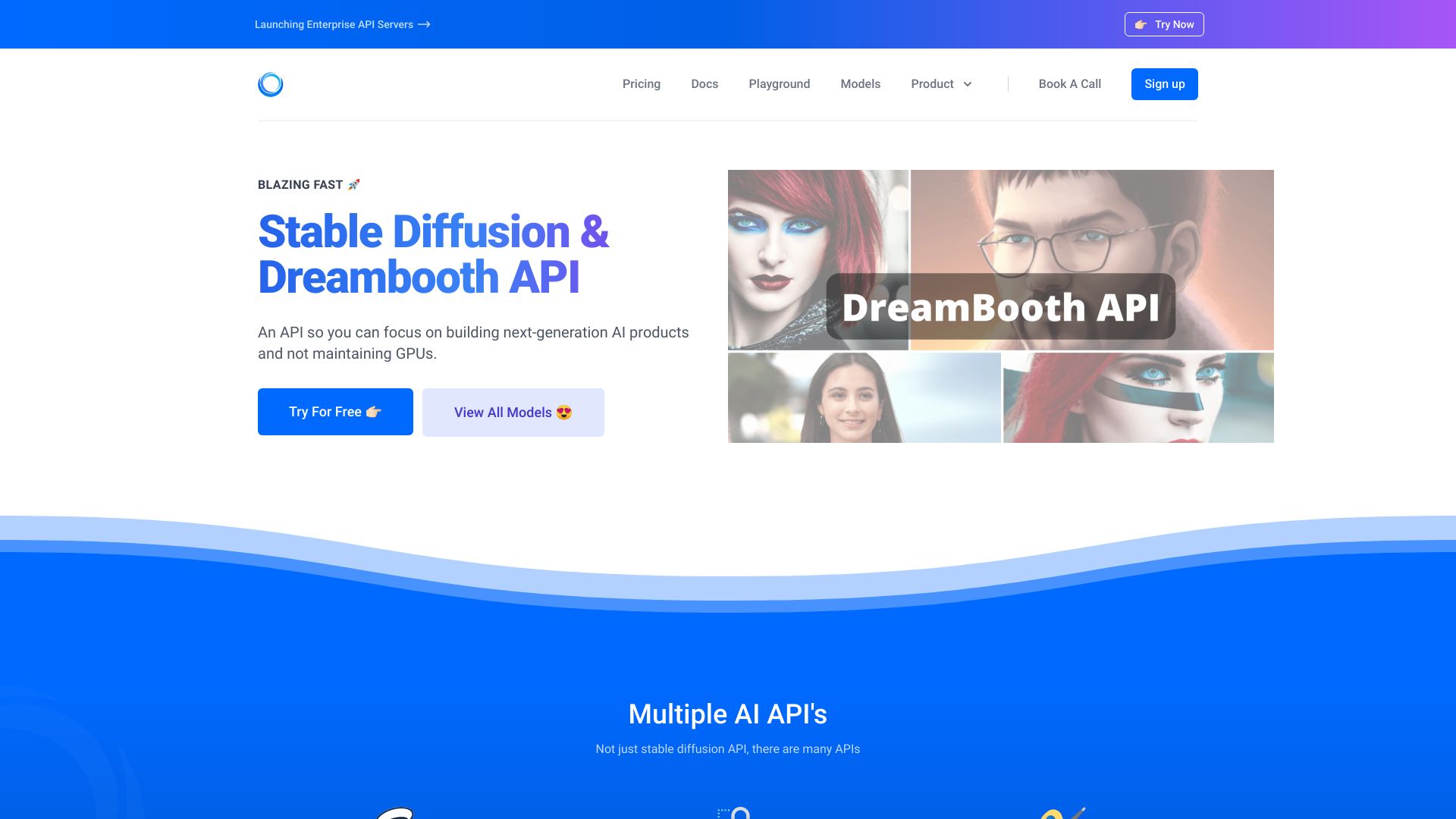
stablediffusion api
Build Next-Gen AI Products Without Maintaining GPUs In today's fast-paced technological landscape, developing next-generation AI products has never been easier. By leveraging cloud-based solutions, businesses can create powerful AI applications without the hassle of maintaining physical GPUs. This approach not only reduces operational costs but also allows for greater scalability and flexibility. Why Choose Cloud-Based AI Solutions? 1. Cost Efficiency: Save on hardware expenses and maintenance costs by utilizing cloud services. 2. Scalability: Easily scale your AI projects according to demand without the need for physical upgrades. 3. Accessibility: Access your AI tools and resources from anywhere, enabling remote collaboration and innovation. Key Features of Cloud-Based AI Platforms - High Performance: Enjoy the power of advanced GPUs in the cloud, optimized for AI workloads. - User-Friendly Interfaces: Simplify the development process with intuitive tools and dashboards. - Robust Security: Protect your data with top-notch security measures implemented by cloud providers. In conclusion, building next-gen AI products without the burden of maintaining GPUs is not only feasible but also advantageous. Embrace cloud technology to enhance your AI capabilities and drive innovation in your business.
AI Project Details
Stable Diffusion API review: hosted image generation API for developers
Stable Diffusion API is a hosted REST API for image generation models including Stable Diffusion 1.5, SDXL, Flux, ControlNet, LoRA, and a catalog of community models. The official homepage positions it as a way to build image products without maintaining GPUs, with a free tier, quick API key setup, and code samples for cURL, Python, and Node. The documentation page covers text-to-image, img2img, inpainting, ControlNet, LoRA, and super resolution workflows.
The strongest fit is a developer or product team that wants to add image generation quickly without building model hosting, GPU scheduling, model switching, and inference infrastructure from scratch.
Best-fit use cases
| Use case | Fit | Notes | |---|---:|---| | Prototype image-generation products | High | One REST endpoint reduces setup time. | | Apps needing multiple model families | High | SDXL, Flux, ControlNet, LoRA, and community models are highlighted. | | Internal creative tooling | Medium to high | Useful when speed matters more than full infra control. | | Strict enterprise ML infrastructure | Medium | Check data, logging, and compliance requirements. | | Custom model hosting ownership | Low to medium | Self-hosting may be better for deep control. |
What users should verify
Teams should test latency, queue behavior, image quality, model availability, rate limits, pricing at real volume, safety checks, image ownership terms, data retention, API reliability, webhook needs, and how failures are handled. For public apps, add moderation, prompt controls, abuse monitoring, and fallback UX.
Strengths
- Developer-oriented REST API with quickstart examples.
- Supports several popular image-generation workflows.
- Avoids early GPU infrastructure work.
- Useful for model experimentation and product prototyping.
Limitations
- Hosted APIs create dependency on provider uptime and model access.
- Cost can rise quickly with image volume and larger models.
- Safety, copyright, and abuse controls still need product-level design.
- Teams with strict data requirements should review policies carefully.
Bottom line
Stable Diffusion API is best for teams that want image generation inside an app quickly. It is not a full product strategy by itself: success still depends on prompt UX, moderation, cost controls, and clear rights handling.
Sources reviewed: Stable Diffusion API homepage, Stable Diffusion API docs, Stable Diffusion API FAQ.
FAQ
What is Stable Diffusion API best for?
Stable Diffusion API is best for developers who want to add hosted image generation to apps without running their own GPU infrastructure.
Which workflows does Stable Diffusion API support?
The official docs describe text-to-image, img2img, inpainting, ControlNet, LoRA, super resolution, and access to multiple model families.
What should teams test before using Stable Diffusion API in production?
Teams should test latency, rate limits, cost at volume, model quality, safety checks, rights terms, data retention, and failure handling.