staff.rip
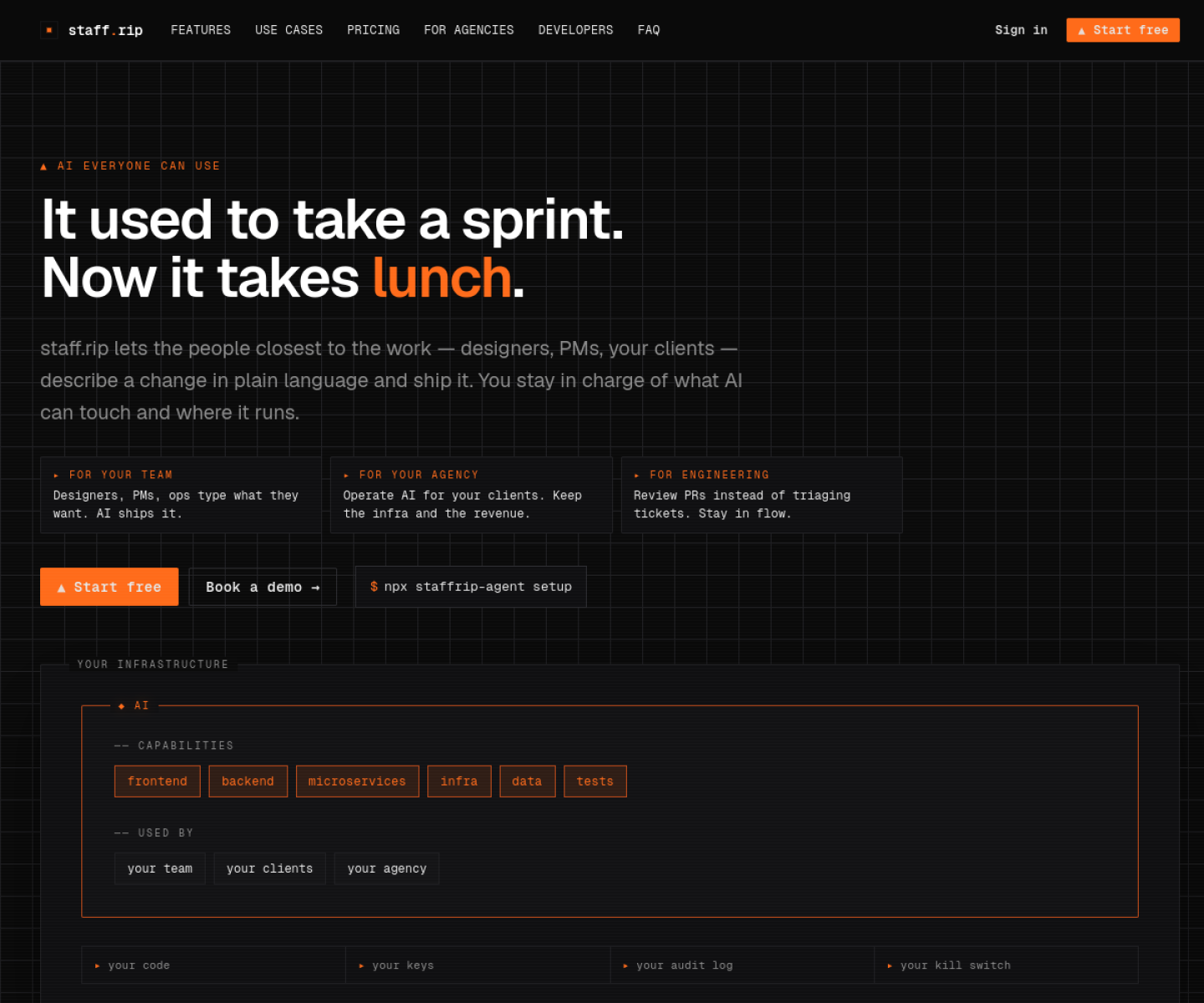
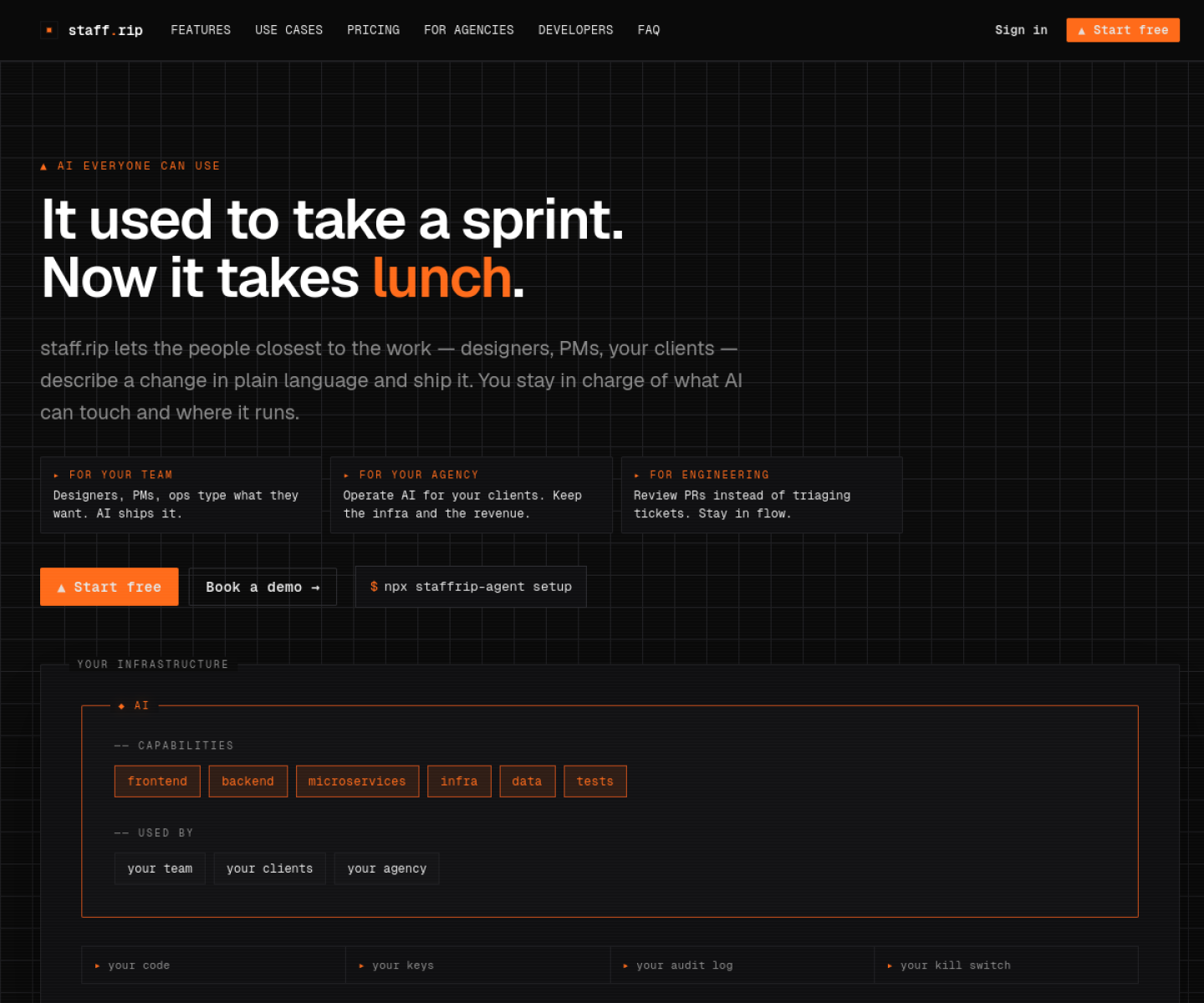
Chat-first AI software delivery layer that keeps agents running in infrastructure you control while non-engineers can request product changes through a simpler interface.
AI Project Details
staff.rip review: Chat-first AI software delivery layer that keeps agents running in infrastructure you control while non-engineers can request product changes through a simpler interface.
staff.rip is built for product teams, agencies, and engineering groups that want ai-assisted shipping without forcing every request through a cli used only by developers. Instead of asking users to replace their whole toolchain, the product wraps a familiar workflow around create a project in staff.rip, connect it to the environment you control, let designers or pms request changes through the ui, and have engineers review the resulting pull requests instead of triaging every ticket manually. That makes it easier to judge on practical fit rather than hype.
What the product changes day to day
The real question is whether the workspace removes enough friction to matter. staff.rip is built around the gap between self-hosted engineering control and a UI simple enough for non-developers to use. The homepage is unusually direct about the product's control model: agents run on your machine or VPC rather than shipping code to a vendor-hosted IDE. Its agency and client-operation angle is distinct from most solo-developer coding-agent launches.
What the workflow feels like
For a serious evaluation, start with one active project instead of a synthetic demo. In practice that means users should create a project in staff.rip, connect it to the environment you control, let designers or pms request changes through the ui, and have engineers review the resulting pull requests instead of triaging every ticket manually. If the product keeps context visible and cuts down tool hopping, the value shows up quickly.
Where it earns attention
| Evaluation angle | Fit | Why it matters | | --- | --- | --- | | Best-fit user | High | Product teams, agencies, and engineering groups that want AI-assisted shipping without forcing every request through a CLI used only by developers. | | Core workflow clarity | High | Create a project in staff.rip, connect it to the environment you control, let designers or PMs request changes through the UI, and have engineers review the resulting pull requests instead of triaging every ticket manually. | | Switching cost reducer | Medium to high | staff.rip is built around the gap between self-hosted engineering control and a UI simple enough for non-developers to use. | | Adoption risk | Medium | The product still depends on teams setting up clear permissions and review boundaries, because easier access to code changes can widen risk if governance is weak. |
Practical use cases
- Letting PMs or designers request safe product changes through AI
- Running coding agents in infrastructure the team controls
- Shifting engineering time from ticket triage toward PR review
Limits and buying notes
The product still depends on teams setting up clear permissions and review boundaries, because easier access to code changes can widen risk if governance is weak. It is a better fit for collaborative product work than for a single developer who already prefers a terminal-only flow. Pricing status today: staff.rip's official homepage shows a free usage-based tier, Pro at 15 euros per user per month, and Enterprise on custom pricing, with optional tunnels and VPS usage billed separately.
FAQ
What is staff.rip best for?
staff.rip is strongest when letting pms or designers request safe product changes through ai matters more than a generic AI demo. The official product materials position it around a concrete workflow rather than a blank chatbot shell.
Who should try staff.rip first?
Product teams, agencies, and engineering groups that want AI-assisted shipping without forcing every request through a CLI used only by developers. Teams with a real workflow match will get value faster than general curiosity users.
What should buyers verify before adopting staff.rip?
The product still depends on teams setting up clear permissions and review boundaries, because easier access to code changes can widen risk if governance is weak. It is a better fit for collaborative product work than for a single developer who already prefers a terminal-only flow. Pricing, privacy, and workflow fit should be checked directly on the current product before rollout.
Reviewed sources
- https://staff.rip/
- https://staff.rip/terms
- https://staff.rip/security
FAQ
What is staff.rip best for?
staff.rip is strongest when letting pms or designers request safe product changes through ai matters more than a generic AI demo. The official product materials position it around a concrete workflow rather than a blank chatbot shell.
Who should try staff.rip first?
Product teams, agencies, and engineering groups that want AI-assisted shipping without forcing every request through a CLI used only by developers. Teams with a real workflow match will get value faster than general curiosity users.
What should buyers verify before adopting staff.rip?
The product still depends on teams setting up clear permissions and review boundaries, because easier access to code changes can widen risk if governance is weak. It is a better fit for collaborative product work than for a single developer who already prefers a terminal-only flow. Pricing, privacy, and workflow fit should be checked directly on the current product before rollout.