
Straion
Rule-management layer for AI coding agents that centralizes engineering standards, injects relevant context into each task, and validates plans or code against those rules.
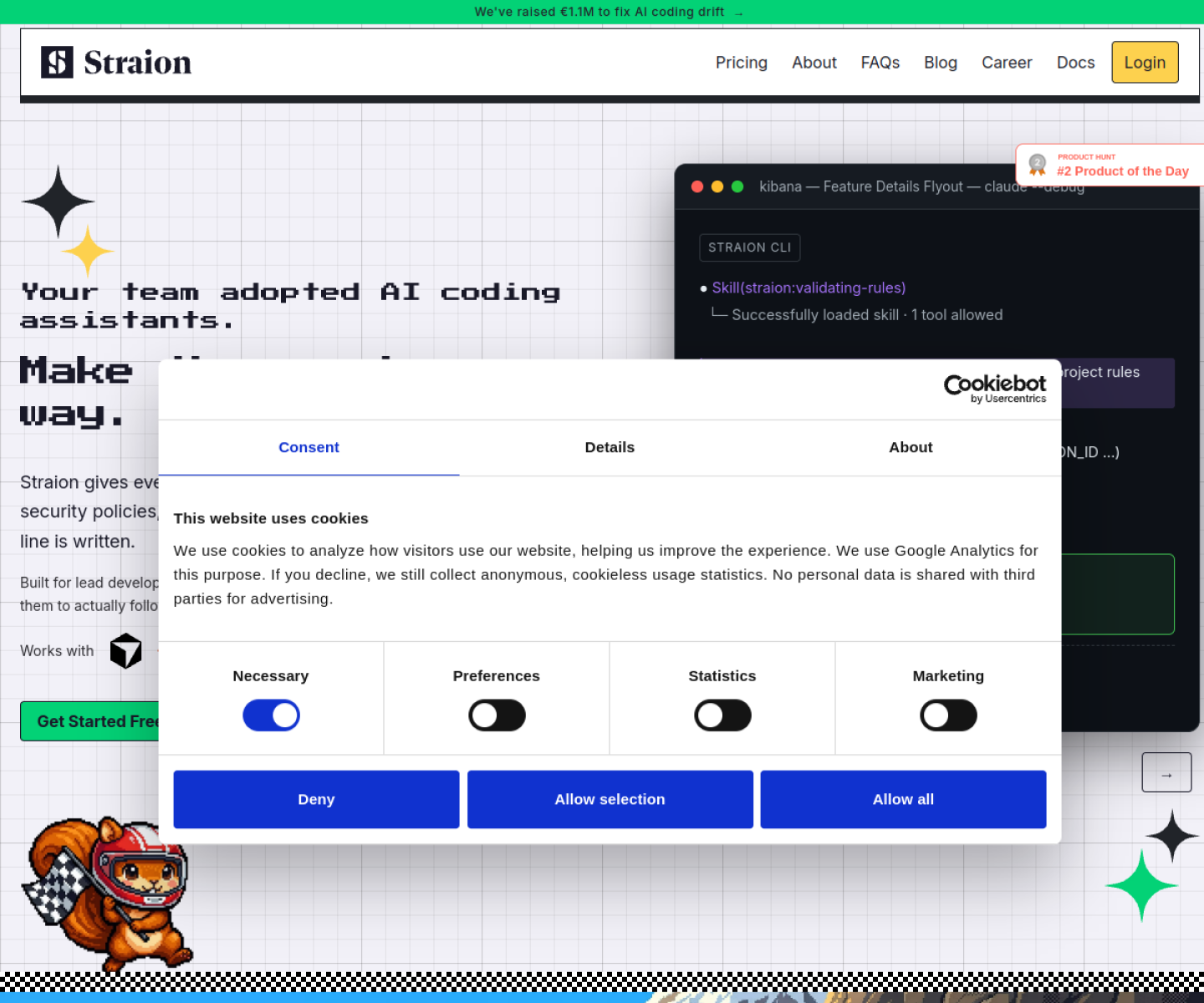
AI Project Details
Straion review: Rule-management layer for AI coding agents that centralizes engineering standards, injects relevant context into each task, and validates plans or code against those rules.
Straion is aimed at engineering teams that already use tools like claude code, cursor, or copilot but need those agents to follow company rules more consistently. The current product materials describe a workflow built around create an account, import rules from github or markdown files, install the straion cli, connect a supported coding agent, and validate plans or diffs before merge. That makes the page easier to read as an operating model, not just a brand claim.
Why it is timely
Straion focuses on rule retrieval and validation instead of assuming a bigger model context window will solve alignment by itself. The docs are concrete about importing existing standards, connecting agents through a CLI, and running validation before coding or before merge. Its positioning is more operational than aspirational: the product is built around reducing drift, review churn, and missed requirements in agent-assisted development.
How the workflow works in practice
A sensible first pass is to start from the product's main entry point and test the shortest path to value. For Straion, that means users should create an account, import rules from github or markdown files, install the straion cli, connect a supported coding agent, and validate plans or diffs before merge. If that loop reduces review drag, coordination, or governance work, the product is doing something real.
Where Straion stands out
| Evaluation angle | Fit | Why it matters | | --- | --- | --- | | Best-fit user | High | Engineering teams that already use tools like Claude Code, Cursor, or Copilot but need those agents to follow company rules more consistently. | | Core workflow clarity | High | Create an account, import rules from GitHub or markdown files, install the Straion CLI, connect a supported coding agent, and validate plans or diffs before merge. | | Switching cost reducer | Medium to high | Straion focuses on rule retrieval and validation instead of assuming a bigger model context window will solve alignment by itself. | | Adoption risk | Medium | Teams still need to write and maintain good source rules, or the system will amplify weak guidance. |
Practical use cases
- Injecting engineering rules into coding-agent tasks automatically
- Validating implementation plans before agents start generating code
- Checking pull requests and diffs against internal security or architecture standards
Limits and buying notes
Teams still need to write and maintain good source rules, or the system will amplify weak guidance. The strongest value shows up in organizations with explicit engineering standards, not solo developers who prefer lightweight repo-local instructions. Pricing status today: The reviewed public pages emphasize a free start and self-serve setup, but a full public pricing matrix was not clearly published during review.
FAQ
What is Straion best for?
Straion is strongest when injecting engineering rules into coding-agent tasks automatically matters more than a generic AI demo. The official product materials position it around a concrete workflow rather than a blank chatbot shell.
Who should try Straion first?
Engineering teams that already use tools like Claude Code, Cursor, or Copilot but need those agents to follow company rules more consistently. Teams with a real workflow match will get value faster than general curiosity users.
What should buyers verify before adopting Straion?
Teams still need to write and maintain good source rules, or the system will amplify weak guidance. The strongest value shows up in organizations with explicit engineering standards, not solo developers who prefer lightweight repo-local instructions. Pricing, privacy, and workflow fit should be checked directly on the current product before rollout.
Reviewed sources
- https://straion.com/
- https://docs.straion.com/getting-started/
- https://docs.straion.com/core-concepts/
FAQ
What is Straion best for?
Straion is strongest when injecting engineering rules into coding-agent tasks automatically matters more than a generic AI demo. The official product materials position it around a concrete workflow rather than a blank chatbot shell.
Who should try Straion first?
Engineering teams that already use tools like Claude Code, Cursor, or Copilot but need those agents to follow company rules more consistently. Teams with a real workflow match will get value faster than general curiosity users.
What should buyers verify before adopting Straion?
Teams still need to write and maintain good source rules, or the system will amplify weak guidance. The strongest value shows up in organizations with explicit engineering standards, not solo developers who prefer lightweight repo-local instructions. Pricing, privacy, and workflow fit should be checked directly on the current product before rollout.