VectorShift
Harness the power of AI to transform your business processes with VectorShift's innovative generative AI platform. This cutting-edge solution enables you to customize workflows, enhance efficiency, and drive growth. By leveraging advanced AI technology, VectorShift empowers businesses to streamline operations and make data-driven decisions. Experience the future of business automation and unlock new opportunities with our user-friendly platform designed for your unique needs. Embrace the potential of generative AI and elevate your business to the next level with VectorShift.
AI Project Details
VectorShift review: AI automation and agent workflows for business teams
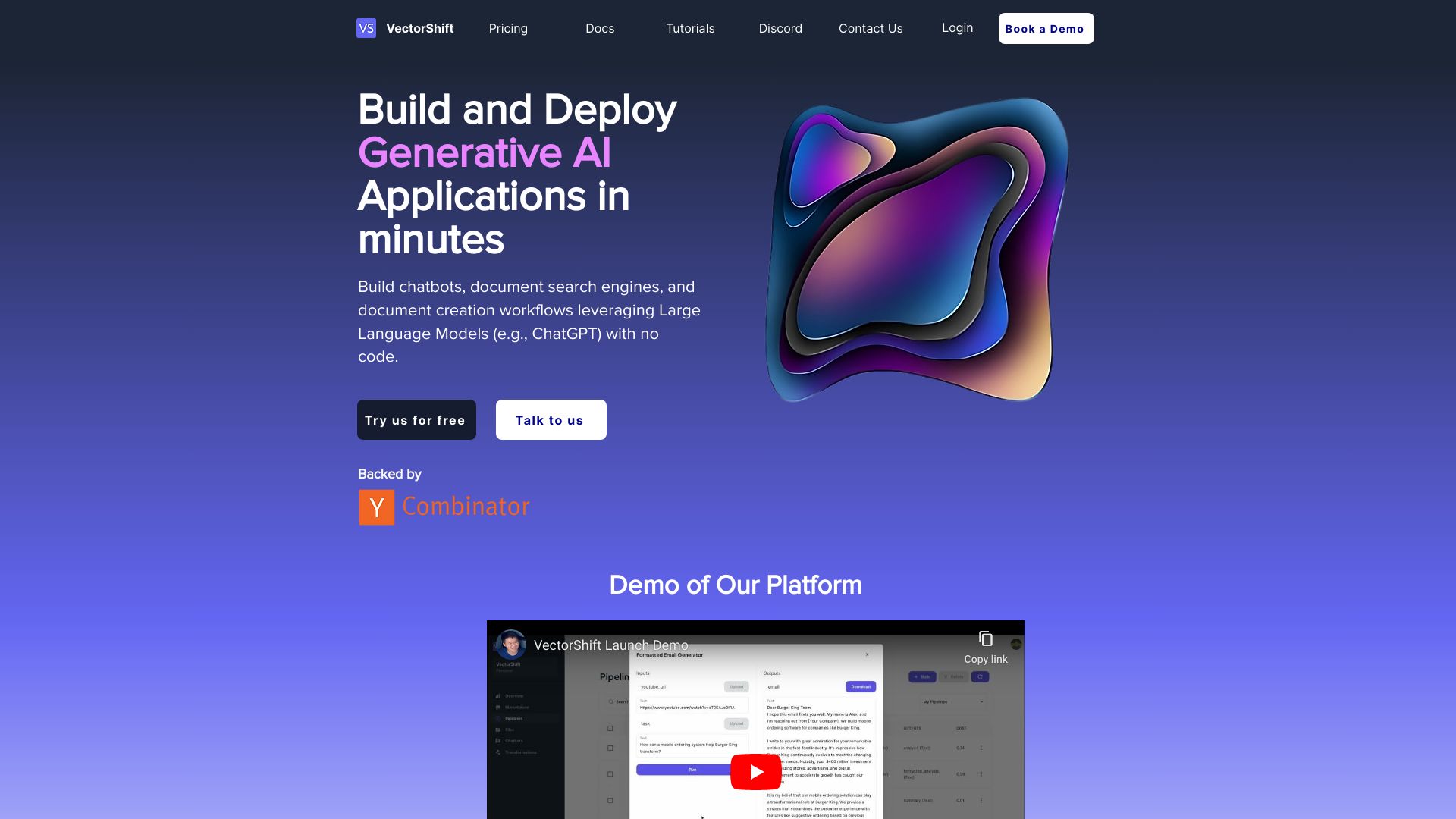
VectorShift is an AI automation platform for building workflows, agents, chatbots, search experiences, and integrations. Its pricing page describes AI credits, usage-based overage, data integrations, and workflow limits. The product is best understood as an AI workflow builder that helps teams connect data sources, model calls, retrieval, forms, and automation without building every orchestration layer from scratch.
The strongest fit is repeatable business workflows where AI is one step in a larger process. A chatbot alone is rarely enough. VectorShift becomes more useful when the workflow needs source retrieval, routing, structured output, API calls, human handoff, and deployment as a tool or assistant.
Best-fit use cases
| Use case | VectorShift fit | Notes | |---|---:|---| | Internal AI workflow automation | High | Strong fit for repeatable workflows that combine data and LLM steps. | | Business chatbots and assistants | Medium to high | Useful when connected to knowledge sources and actions. | | Retrieval-based workflows | Medium to high | Good fit when search and generation need to work together. | | Prototype AI tools | Medium to high | Visual workflows can speed early product and operations experiments. | | Deep custom AI infrastructure | Medium | Code-first systems may fit complex, high-scale architectures better. |
What to evaluate before rollout
AI workflow builders can produce value quickly, but they can also become hard to maintain if workflows are vague. Teams should test versioning, observability, error handling, data connectors, permission controls, model choices, retrieval quality, AI credit usage, and whether business users can update workflows without breaking them.
Strengths
- Useful visual workflow layer for AI assistants, automations, and connected tools.
- Can reduce the effort needed to combine knowledge sources, prompts, actions, and APIs.
- Good fit for operations teams experimenting with repeatable AI workflows.
- Usage-based credits make costs visible if teams monitor them actively.
Limitations
- Complex workflows still need engineering review and governance.
- AI credit and overage costs should be modeled before broad deployment.
- Quality depends on source data, workflow design, prompt discipline, and evaluation.
- Buyers should compare against Dify, Langflow, n8n, BuildShip, and custom orchestration.
TakeAI verdict
VectorShift is worth indexing as a business AI automation platform. The best pilot is one well-defined workflow, such as support triage, document intake, lead enrichment, or internal knowledge Q&A, with metrics for accuracy, time saved, escalation rate, cost per run, and maintainability.
Sources reviewed: VectorShift pricing.
FAQ
What is VectorShift best for?
VectorShift is best for building AI workflows, business automations, agents, chatbots, retrieval workflows, and internal tools that connect data sources with model calls.
Is VectorShift only a chatbot builder?
No. Chatbots are one use case, but the broader value is workflow automation that can include retrieval, prompts, actions, APIs, forms, and routing.
What should teams test before adopting VectorShift?
Test workflow versioning, connector reliability, error handling, cost per run, source-data quality, retrieval accuracy, permission controls, and human handoff.